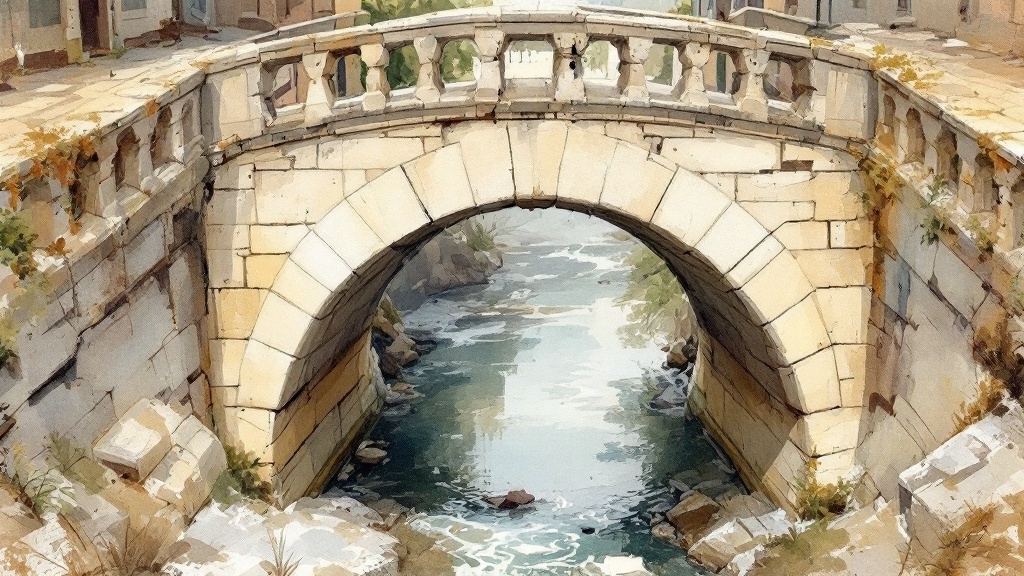
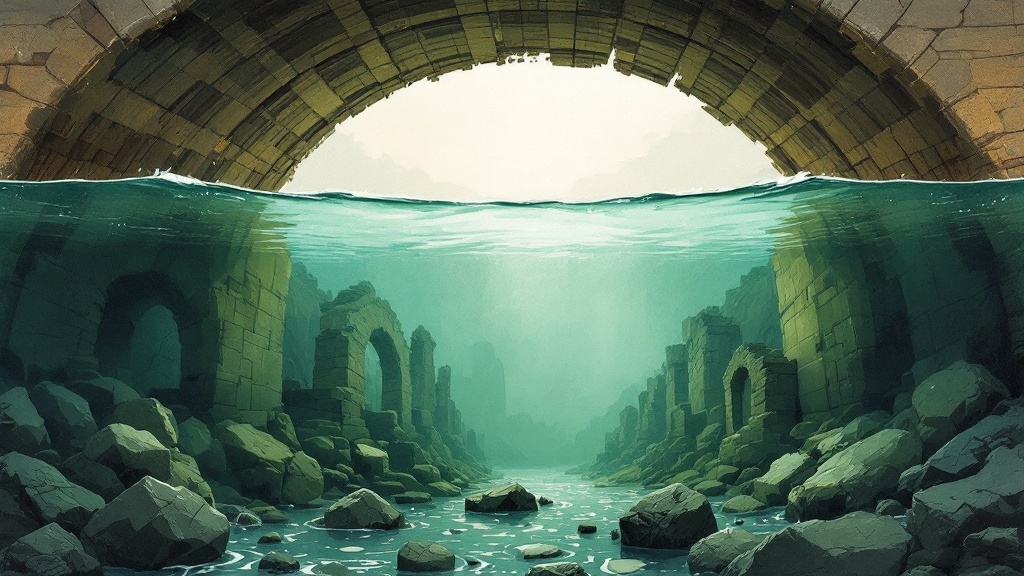
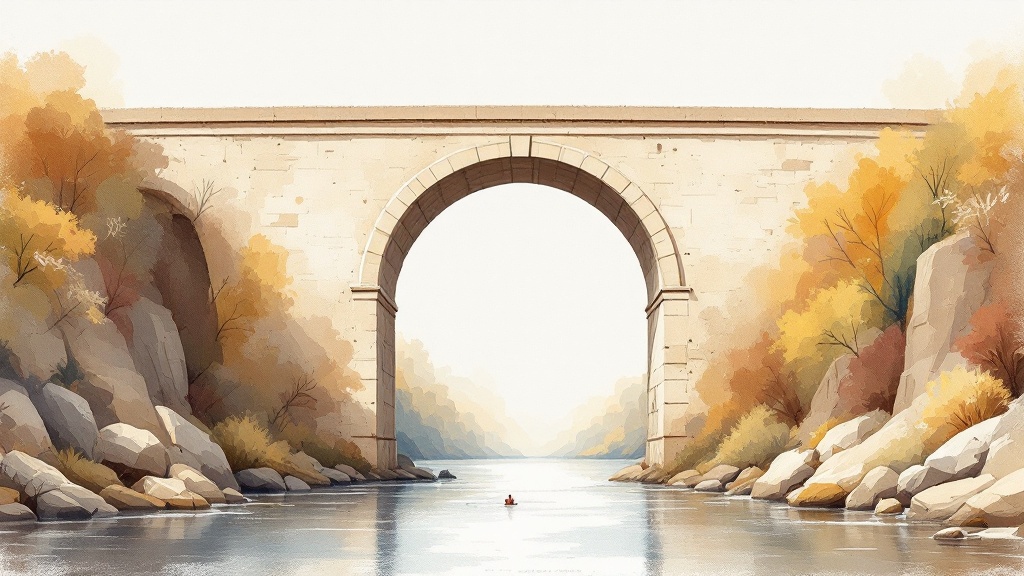
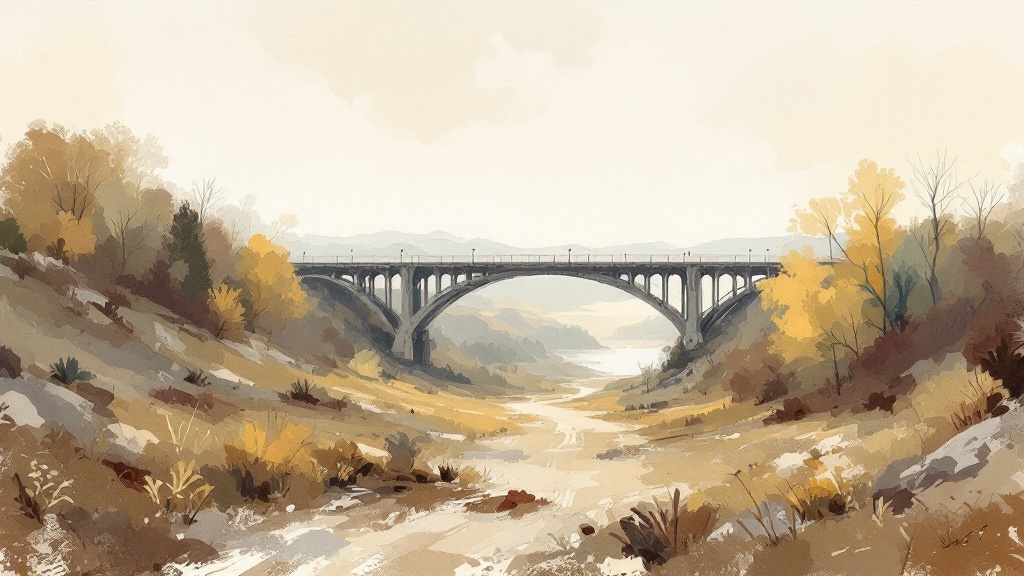
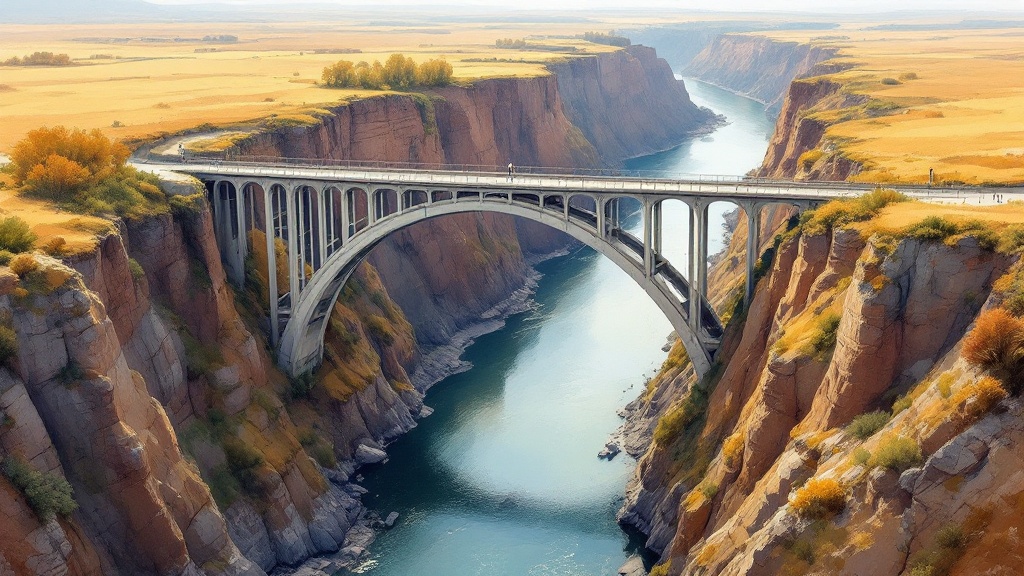
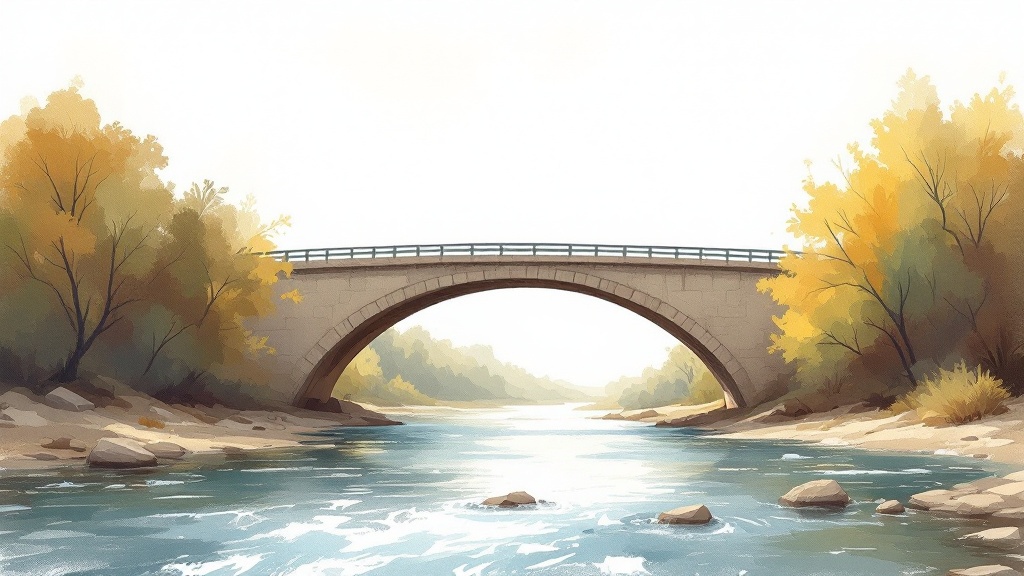
The Bridge
Growth often arrives before readiness.
Story Arc
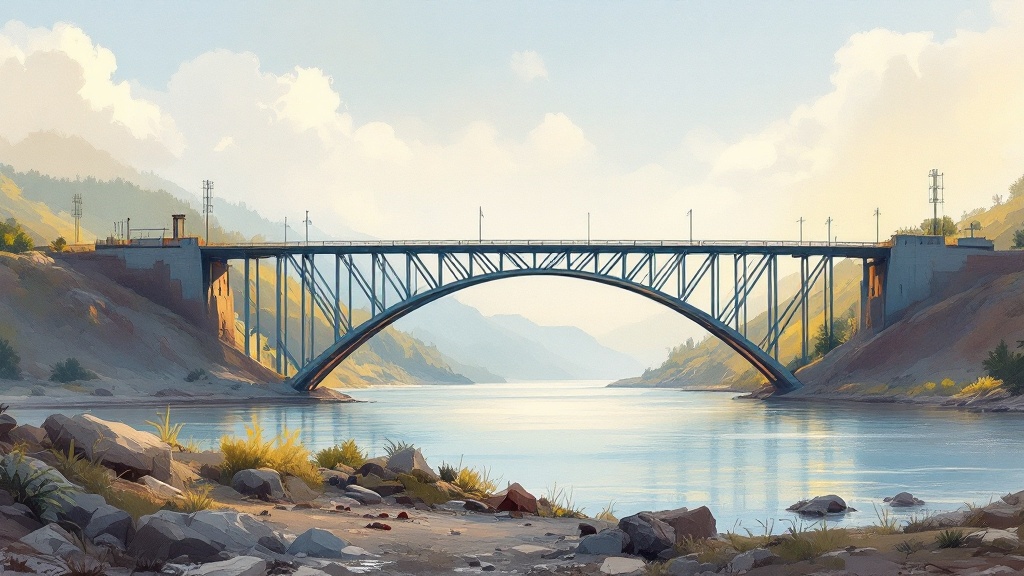
- A young bridge carries light crossings
- Villages prosper; traffic increases
- Weight grows faster than support
- The bridge feels useful, not strained
- Load accumulates unnoticed
- The bridge collapses under ordinary demand
- It is rebuilt deeper
- Its ruins become part of the foundation
- The bridge carries weight again
- Trade grows; load increases once more
- Strain returns, slower than before
- A second collapse occurs, smaller
- Reinforcement accumulates beneath the surface
- Capacity grows alongside weight
- The bridge no longer fears the load it carries
Foundation & Spine
foundation_locked.md
Universal Pattern: Capacity–Load Learning Arc
Pattern Name: Capacity–Load Learning Arc Core Misalignment: Structural Underdevelopment Key Powers: Capacity, Growth, Momentum, Time
Universal Beats (15 beats)
| # | Beat Name | Description |
|---|---|---|
| 1 | Initial Capacity | A system begins functional but limited. |
| 2 | Early Growth | Demand, responsibility, or weight increases. |
| 3 | Action Before Readiness | Engagement happens before full preparation. |
| 4 | Strain Emerges | Load exceeds current capacity. |
| 5 | Failure / Collapse | Breakdown occurs due to mismatch, not malice. |
| 6 | Continuation Without Withdrawal | The system remains; connection or commitment holds. |
| 7 | Reinforcement | What broke is strengthened structurally. |
| 8 | Return to Function | The system carries load again. |
| 9 | Repeated Growth | Demand increases once more. |
| 10 | Reduced Failure | Breakdown is smaller, slower, or partial. |
| 11 | Accumulated Learning | Reinforcement compounds across cycles. |
| 12 | Embedded Capacity | Strength becomes part of the structure. |
| 13 | Familiarity with Strain | Pressure is recognized without fear. |
| 14 | Synchronized Growth | Capacity and load rise together. |
| 15 | Enduring Strength | What once broke now holds by default. |
Core Idea
Author's exact words (verbatim — never paraphrase):
"Growth often arrives before readiness."
My restatement (for verification only — downstream agents see author's exact words): Systems are tested by demand before they are prepared for it; the gap between what they can bear and what arrives is not a flaw to be ashamed of, but the very condition through which lasting capacity is built.
Validation: If the author read my restatement, would they say "Yes, you get it"? Yes — the restatement captures both the inevitability of early overwhelm and the productive, structural nature of the learning that follows. It does not flatten the idea into a motivational slogan, nor does it introduce a foreign philosophical angle.
Philosophical Stance: This story does not argue that failure is bad luck or poor planning. It argues that mismatch between capacity and load is the mechanism of growth — not its obstacle. The lens is structural, not moral. Systems do not fail because something is wrong with them. They fail because demand is honest and structure must answer honestly in return.
Compressed Beat → Universal Beat Mapping
Mapping Table (N=15 Compressed → M=15 Universal):
| Universal Beat # | Universal Beat Name | Compressed Beat(s) | Mapping Type | Notes |
|---|---|---|---|---|
| 1. Initial Capacity | A system begins functional but limited. | Beat 1 | 1:1 | Young bridge, light crossings — baseline established |
| 2. Early Growth | Demand, responsibility, or weight increases. | Beat 2 | 1:1 | Villages prosper, traffic increases — load entering |
| 3. Action Before Readiness | Engagement happens before full preparation. | Beat 3 | 1:1 | Weight grows faster than support — engagement outpacing structure |
| 4. Strain Emerges | Load exceeds current capacity. | Beat 4, Beat 5 | 1:many | Beat 4 = bridge feels useful but not strained (invisible strain); Beat 5 = load accumulates unnoticed (strain hidden beneath surface) |
| 5. Failure / Collapse | Breakdown occurs due to mismatch, not malice. | Beat 6 | 1:1 | Collapse under ordinary demand — the definitive mismatch moment |
| 6. Continuation Without Withdrawal | The system remains; connection or commitment holds. | Beat 7 | 1:1 | Rebuilt deeper — commitment expressed through reconstruction |
| 7. Reinforcement | What broke is strengthened structurally. | Beat 8 | 1:1 | Ruins become part of the foundation — prior failure literally embedded |
| 8. Return to Function | The system carries load again. | Beat 9 | 1:1 | Bridge carries weight again — restored to service |
| 9. Repeated Growth | Demand increases once more. | Beat 10 | 1:1 | Trade grows, load increases — second cycle of demand |
| 10. Reduced Failure | Breakdown is smaller, slower, or partial. | Beat 11, Beat 12 | 1:many | Beat 11 = strain returns but slower; Beat 12 = second collapse, smaller — both together constitute reduced failure |
| 11. Accumulated Learning | Reinforcement compounds across cycles. | Beat 13 | 1:1 | Reinforcement accumulates beneath the surface — compounding |
| 12. Embedded Capacity | Strength becomes part of the structure. | Beat 13 | many:1 | Beat 13 also serves this — reinforcement accumulating IS embedding capacity; shared beat is appropriate |
| 13. Familiarity with Strain | Pressure is recognized without fear. | Beat 14 | 1:1 | Capacity grows alongside weight — the bridge now meets strain as partner |
| 14. Synchronized Growth | Capacity and load rise together. | Beat 14 | many:1 | Beat 14 also serves this — capacity growing alongside weight IS synchronization |
| 15. Enduring Strength | What once broke now holds by default. | Beat 15 | 1:1 | Bridge no longer fears the load it carries — enduring strength arrived |
Mapping Validation:
- Sequence check: Compressed beats 1→15 map to universal beats 1→15 in non-decreasing order. ✅
- No beat maps to a lower universal beat than the beat before it.
- Coverage check: All 15 universal beats appear at least once in the mapping column. ✅
- Universal beats 11 and 12 share compressed beat 13; universal beats 13 and 14 share compressed beat 14. These many:1 mappings are valid — each universal beat is still touched.
- Completeness check: Every compressed beat (1–15) has exactly one universal beat assignment. ✅
- Beats 4 & 5 → Universal Beat 4 (expansion); Beats 11 & 12 → Universal Beat 10 (expansion); Beat 13 → Universal Beats 11 & 12 (compression); Beat 14 → Universal Beats 13 & 14 (compression).
All validation checks pass. ✅
Note on Beat 13 (compression): Compressed beat 13 ("Reinforcement accumulates beneath the surface") serves both Universal Beat 11 (Accumulated Learning) and Universal Beat 12 (Embedded Capacity) because these two ideas arrive simultaneously in this story — the accumulation of learning and its embedding into structure are not sequential events here but a single physical reality: the ruins-become-foundation that deepen with each repair. This is a legitimate narrative compression.
Note on Beat 14 (compression): Compressed beat 14 ("Capacity grows alongside weight") serves both Universal Beat 13 (Familiarity with Strain) and Universal Beat 14 (Synchronized Growth) because recognizing strain without fear and growing capacity in tandem with load are, at this stage of the bridge's life, the same moment described from two angles. The story earns this compression through the previous eleven beats.
Metaphor System Verification
Extracted Metaphor System:
| Element | What It Represents | Illuminates Pattern Beats? | Serves Core Idea? | Can trace to wisdom? |
|---|---|---|---|---|
| Bridge | Any system with capacity — financial, personal, organizational | ✅ Beats 1, 6, 7, 8, 9, 12, 14, 15 | ✅ The bridge is the site where "growth before readiness" is tested and resolved | ✅ The bridge's arc shows how a system moves from limited to enduring |
| Traffic / Load | Demand — commerce, responsibility, life weight | ✅ Beats 2, 3, 4, 5, 9, 10, 11, 13, 14 | ✅ Load is the honest pressure that reveals capacity's true edge | ✅ Load arrives before the bridge is ready; this is the engine of growth |
| Collapse | Failure due to structural mismatch, not malice or weakness of character | ✅ Beats 5, 6, 12 | ✅ Collapse is not the story's villain — it is the teacher | ✅ The gap between load and capacity expressed physically |
| Ruins / Foundation | Prior failure embedded as structural knowledge | ✅ Beats 7, 8, 13 | ✅ Directly embodies "capacity retained as structure" from the engine lessons | ✅ The physical trace of what was learned — failure becomes the ground beneath future strength |
| Villages / Trade | The world whose growth creates the demand | ✅ Beats 2, 10 | ✅ External prosperity is what generates load — the world does not wait for the bridge to be ready | ✅ Illustrates the inevitability of "growth arrives before readiness" |
| Depth of Rebuilding | Structural reinforcement — the quality of response to failure | ✅ Beats 7, 8, 13, 14 | ✅ Response to collapse determines whether failure becomes foundation or just rubble | ✅ The bridge rebuilt deeper = readiness developing in response to what load revealed |
All metaphorical elements serve both pattern and core idea. ✅
Validation Questions — Answered
1. Can you restate the core idea in your own words without losing its essence? Yes. Demand arrives before structures are fully capable of meeting it. This gap is not a defect — it is the mechanism by which lasting capacity is built. What collapses is not wasted; it becomes the foundation of what will not collapse next time.
2. Can you explain the universal pattern's arc without referencing this specific story? Yes. A system starts functional but limited. Load increases — often faster than the system can respond. The system acts before it is ready, strains, and eventually fails. But the system stays in place; the relationship between system and load continues. Repair goes deeper than the original build. The system returns to function, carries more, and at some point fails again — but smaller, slower. Each failure adds to what is embedded in the structure. Eventually, load and capacity synchronize, and what once reliably broke now reliably holds.
3. Does the mapping make sense? (Are beats in logical positions?) Yes. The 15 compressed beats follow the universal arc without skipping or reversing. The two compressions (beats 13 and 14) are logically defensible: in this story, accumulated learning and embedded capacity arrive together, and familiarity with strain and synchronized growth arrive together. These are natural collapses in a 15-beat story tracking a multi-generational arc.
4. Does every element of the metaphor system serve both pattern and idea? Yes. The bridge (system), traffic (load), collapse (failure), ruins-as-foundation (retained learning), villages/trade (external demand growth), and depth of rebuilding (reinforcement quality) each illuminate a specific phase of the pattern and, simultaneously, express the core idea: growth before readiness, capacity revealed and retained through failure.
Target Specifications
- Word Count Target: ~3,750 words
- Delivery Mode: Oral / video narration
- Speaking Pace: 150 wpm
- Duration Target (inferred): ~25 minutes at 150 wpm for 3,750 words
spine.md
Question 1: What is the core idea?
Author's exact words:
"Growth often arrives before readiness."
This is the philosophical truth the story teaches. It is not a warning. It is not a consolation. It is a description of how systems — bridges, people, wealth — actually work. Demand is honest. Structure must catch up. This is the law.
Question 2: What is the moral lesson?
How the griot would state the core idea to the audience:
"The load does not wait for the bridge to be ready. It never has. It never will. This is not cruelty. This is how strength is made."
Process note: The core idea — "Growth often arrives before readiness" — is translated into griot voice by grounding it in the story's physical reality (load, bridge, readiness) and then lifting to the universal without abstraction. The moral is embedded in image, not stated as principle. The second and third sentences answer the emotional question the listener will have upon hearing the first: Is this fair? Is something wrong with the bridge? The answer — no, this is how strength is made — closes with a declarative that trusts the listener to carry the rest.
Question 3: What is the feeling arc?
- Beginning: Quiet wonder — the small sufficiency of a young thing doing its work
- Middle: Dread without villain — the accumulation of ordinary weight toward inevitable collapse; grief that is not tragedy, because nothing was wrong, only unlevel
- End: Earned solidity — not triumph, not relief, but the deep and unshowy confidence of something that has been tested and held
Full arc: Quiet wonder → Dread without villain → Earned solidity
Question 4: What is the central image/metaphor?
A bridge that does not fear the load it carries — because the load has already broken it, and what broke has become part of what holds.
This image is the story's spine in a single phrase. It contains:
- The early innocence (the bridge that has not yet been tested)
- The necessary failure (the breaking)
- The transformation (ruins into foundation)
- The resolution (no longer fears)
It is physically grounded — a bridge, a load — and philosophically complete — fear dissolved not by avoidance but by experience absorbed into structure.
Question 5: What changes in audience understanding?
They arrive thinking: "Failure means something went wrong. A collapse means the bridge — or the person, or the plan — was not good enough."
They leave thinking: "Collapse is what capacity looks like before it has been taught by load. The bridge that has never broken has never been fully built. Failure is not the opposite of strength — it is part of how strength accumulates."
The shift is specific: From failure-as-verdict to failure-as-instruction. From collapse as evidence of inadequacy to collapse as the price of structural learning. The audience moves from judging the bridge (and themselves) to understanding the arc that bridges — and wealth, and people — must travel.
Question 6: What and who is being honored?
The core idea, restated: "Growth often arrives before readiness."
What is being honored: The intelligence of systems that fail and continue. The honesty of load. The dignity of a thing that collapses without malice and is rebuilt deeper. The accumulation that happens beneath the surface, unseen, until it is not needed to be seen — because it holds.
The wealth pillar: This story lives in the wealth pillar — financial capacity, economic systems, the reality that prosperity arrives faster than the structures meant to hold it. The bridge honors every person who built something that broke before it was ready, stayed in the work, rebuilt deeper, and eventually carried weight they once could not have imagined. It does not flatter them. It names their arc.
Beats (15/15 complete)
Final Story
The Bridge — Final Performance Draft
Pattern: Capacity–Load Learning Arc Core Idea: "Growth often arrives before readiness." Estimated Performance Duration: ~25 minutes at 150 wpm Word Count: 3,968
Performance Notes (Overall)
- Start quiet. The opening is a young thing doing its work. No urgency.
- The story has two collapses (Beats 6 and 12) and two held heartbeats (Beat 6: the tilt; Beat 8: the midspan echo). These are the spine made physical. Slow at both.
- Three places require a full landed silence after the line: Beat 10 ("Again."), Beat 12 ("He did not yet know."), and Beat 15 ("That was all."). Do not rush past them.
- The griot is a warm elder, not a performer. Trust the bridge to teach. Let the audience carry the rest.
Beat 1: A young bridge, light crossings
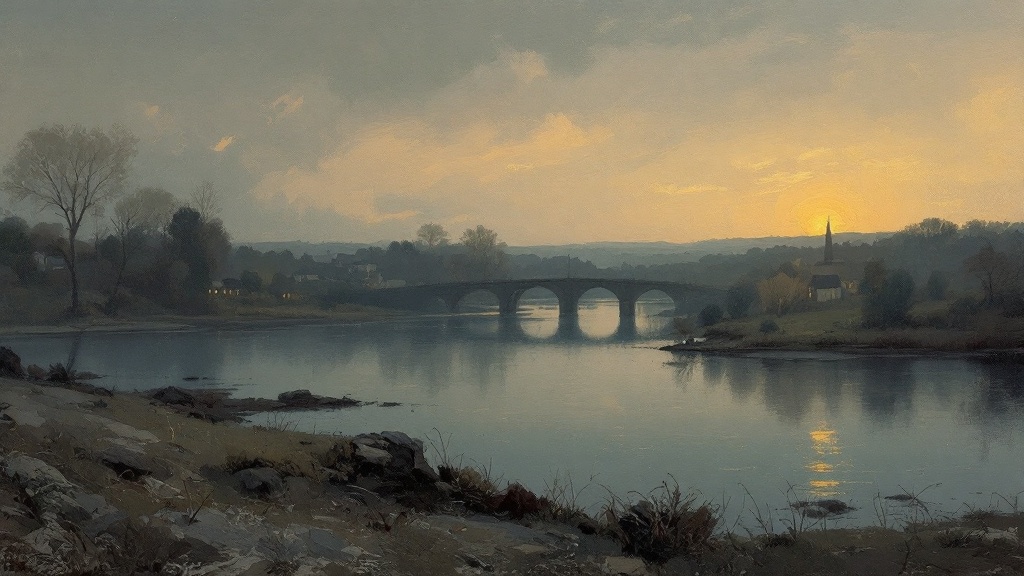
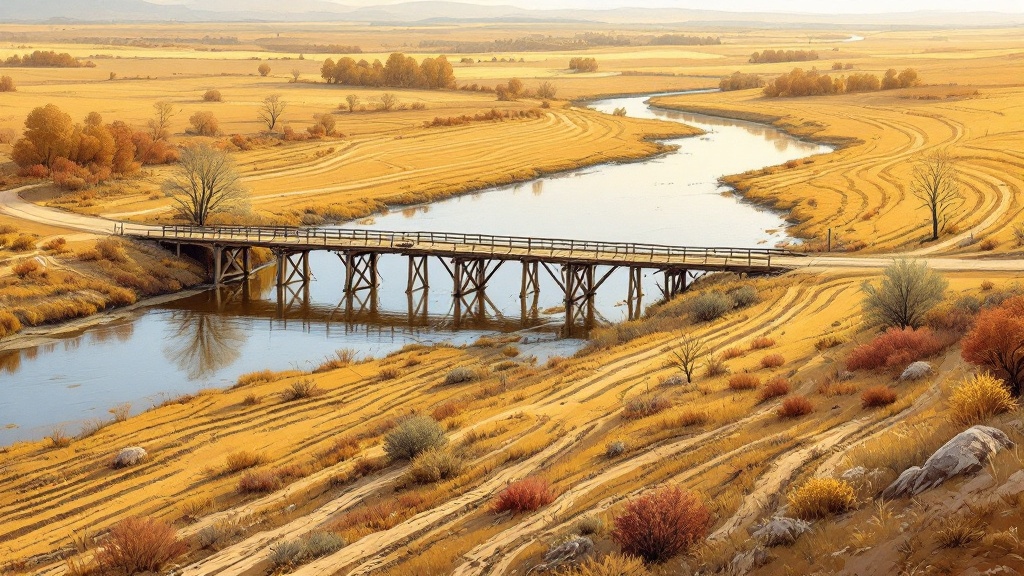
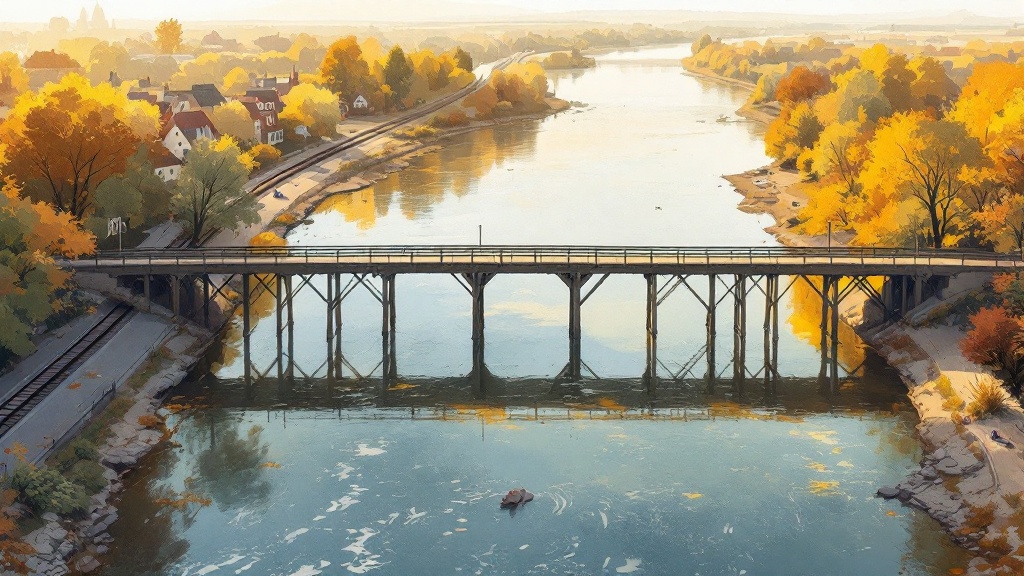
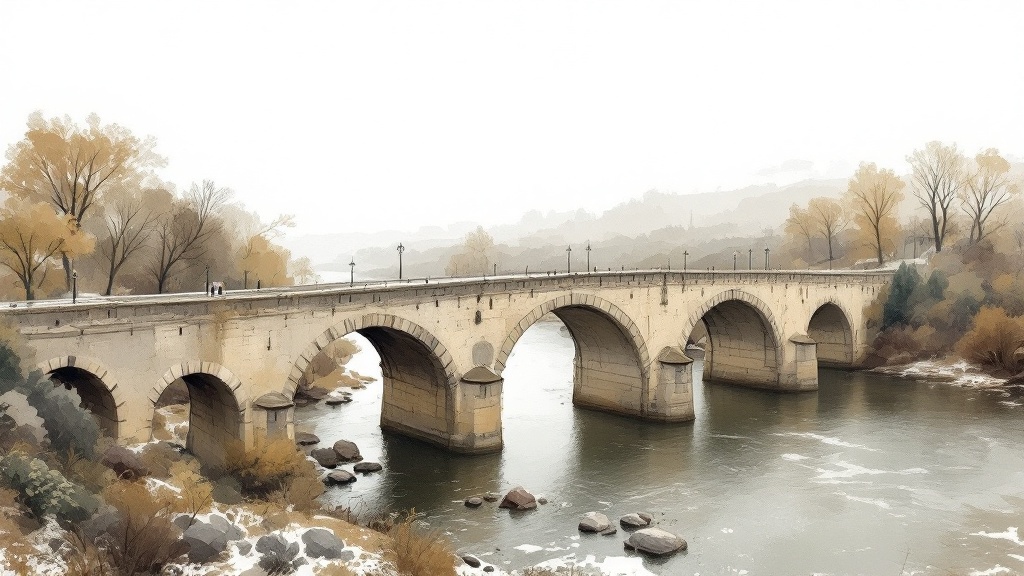
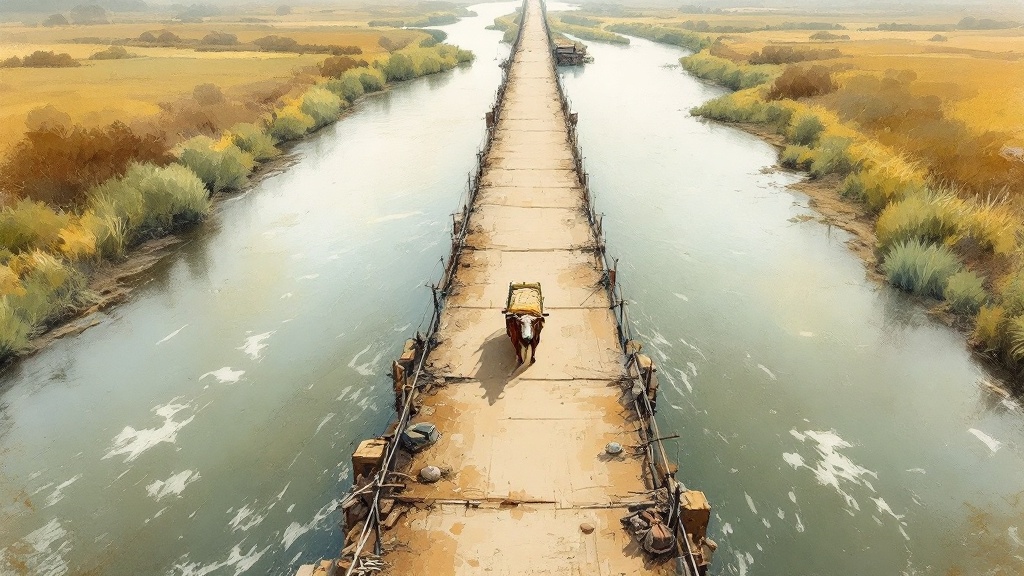
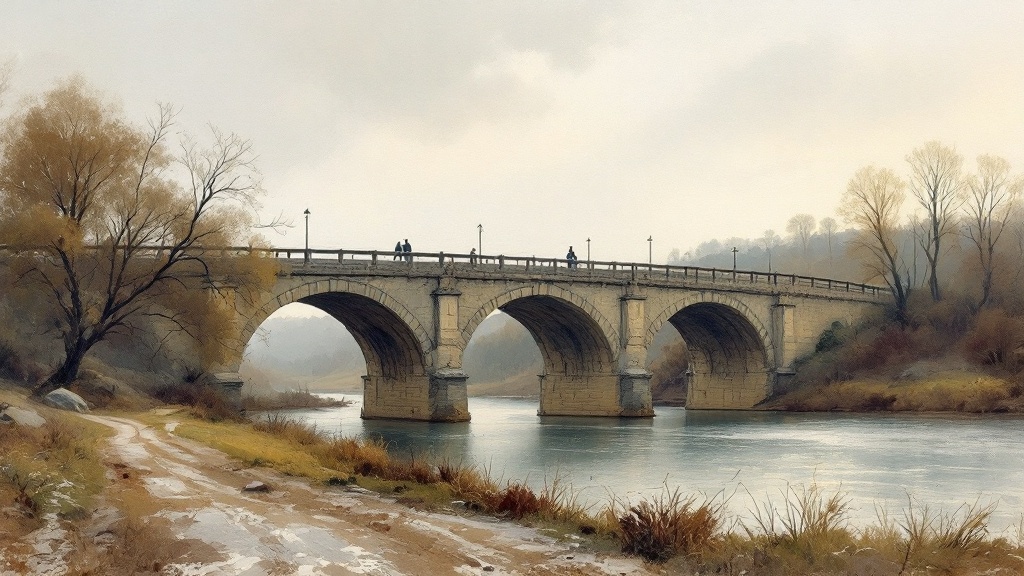
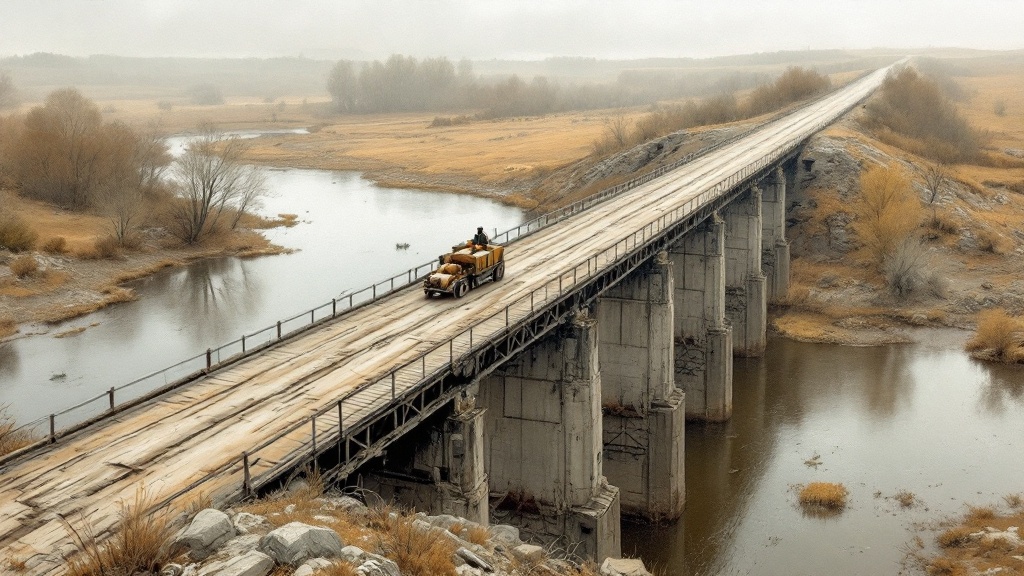
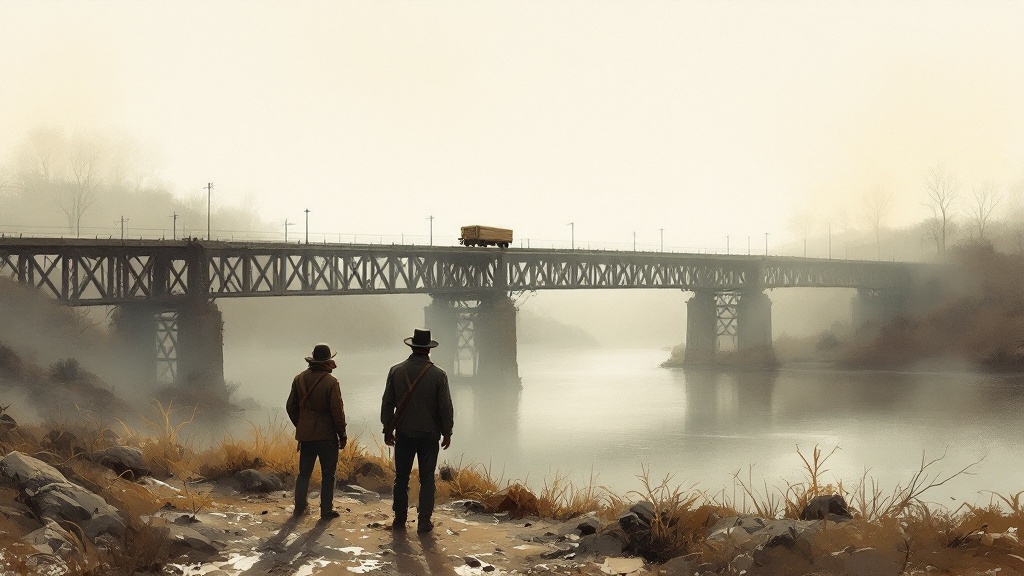
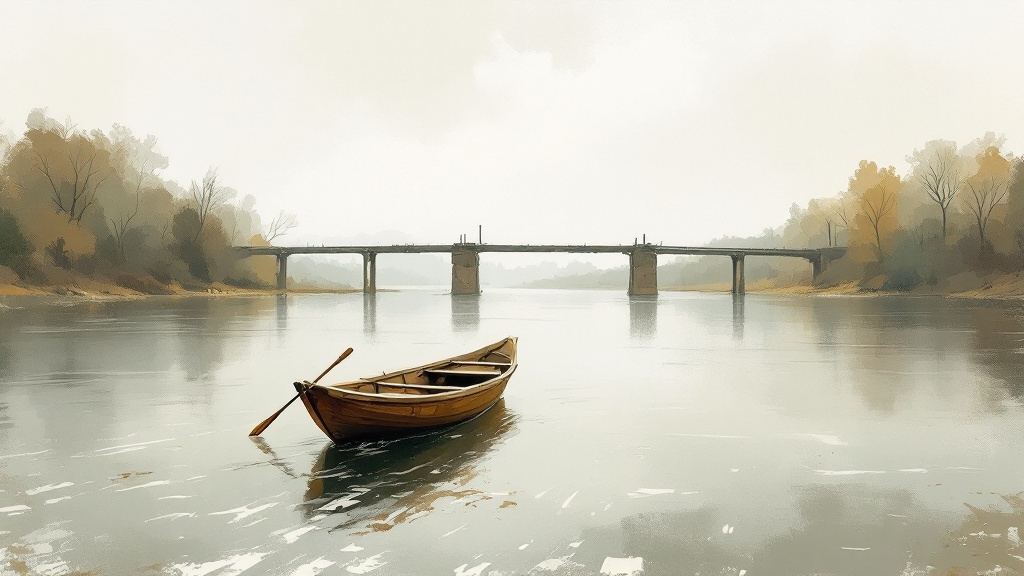
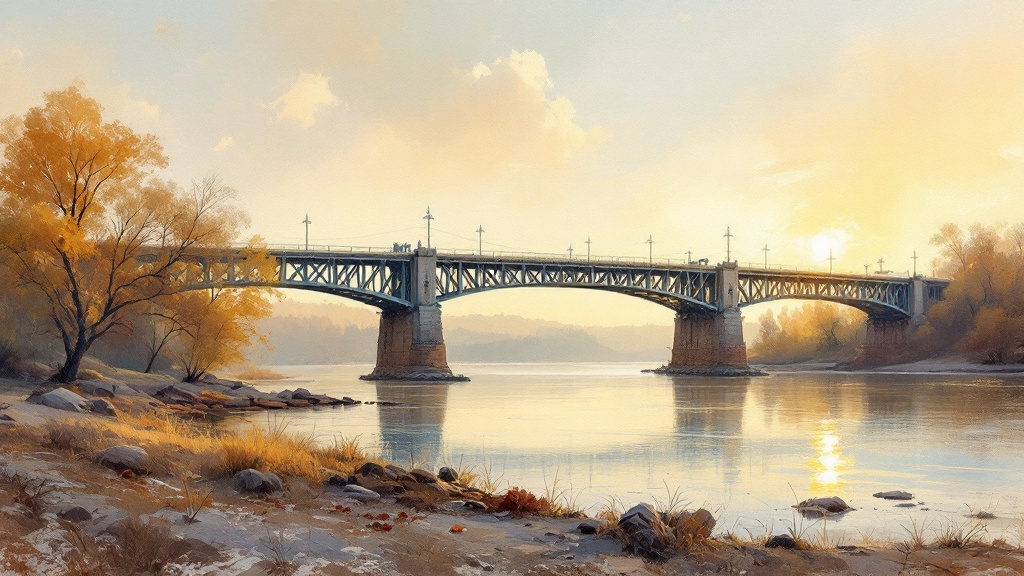
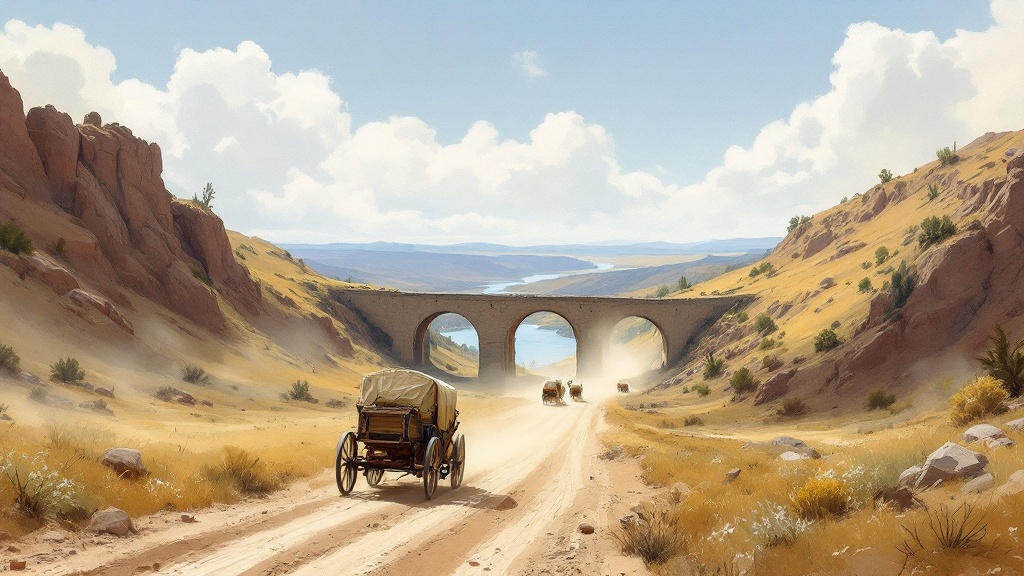
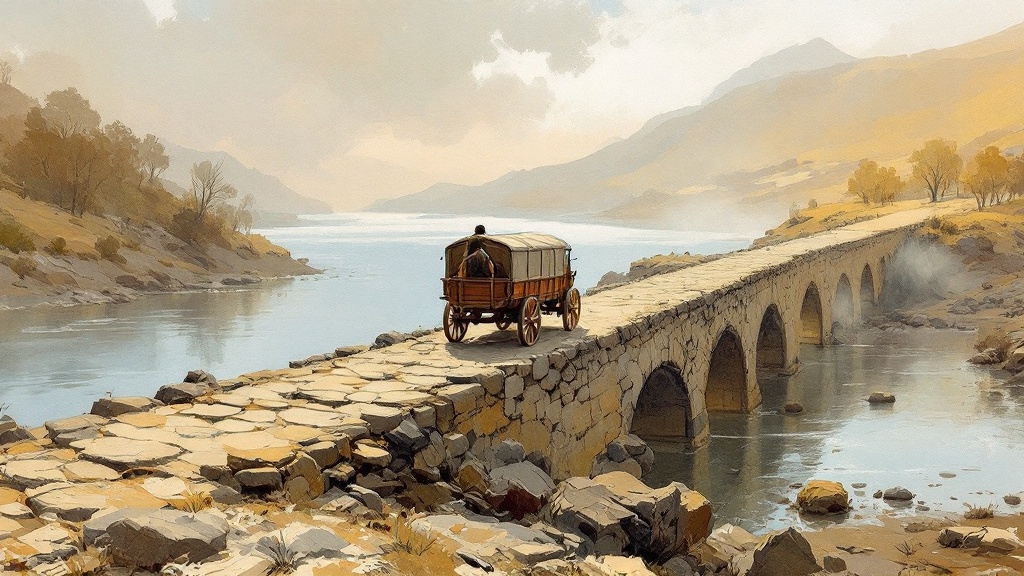
Between two villages, a narrow river ran. A bridge crossed it.
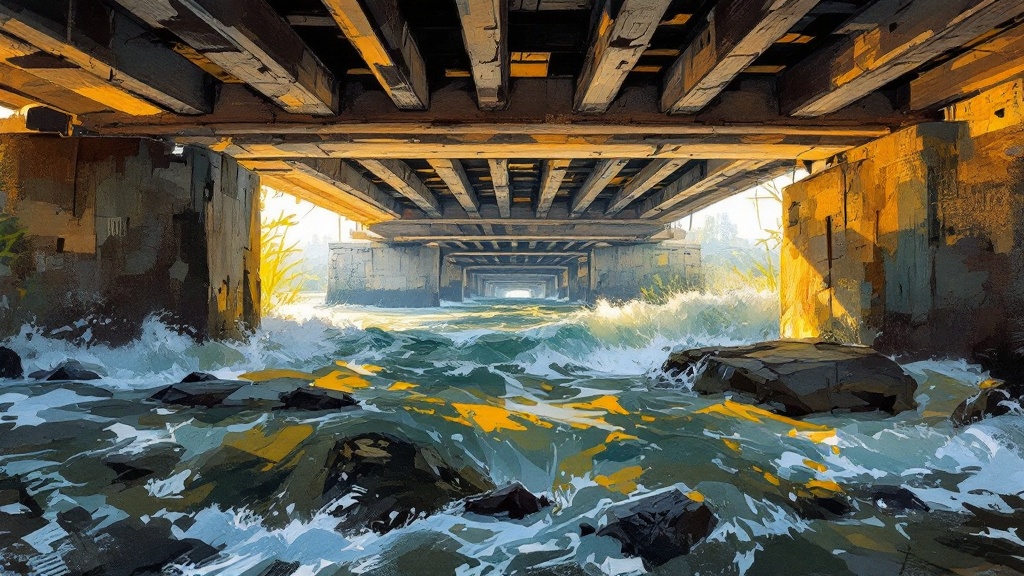
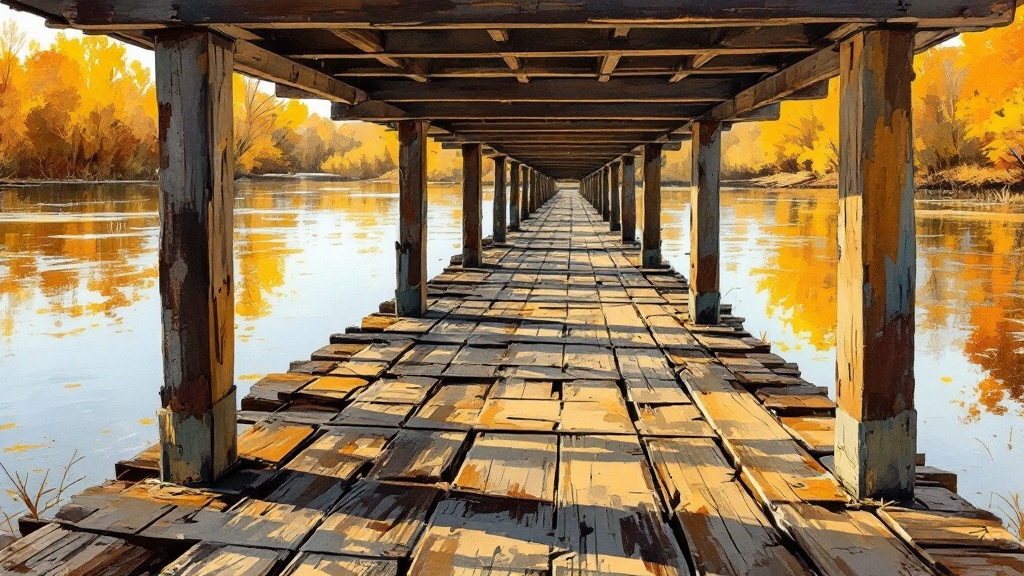
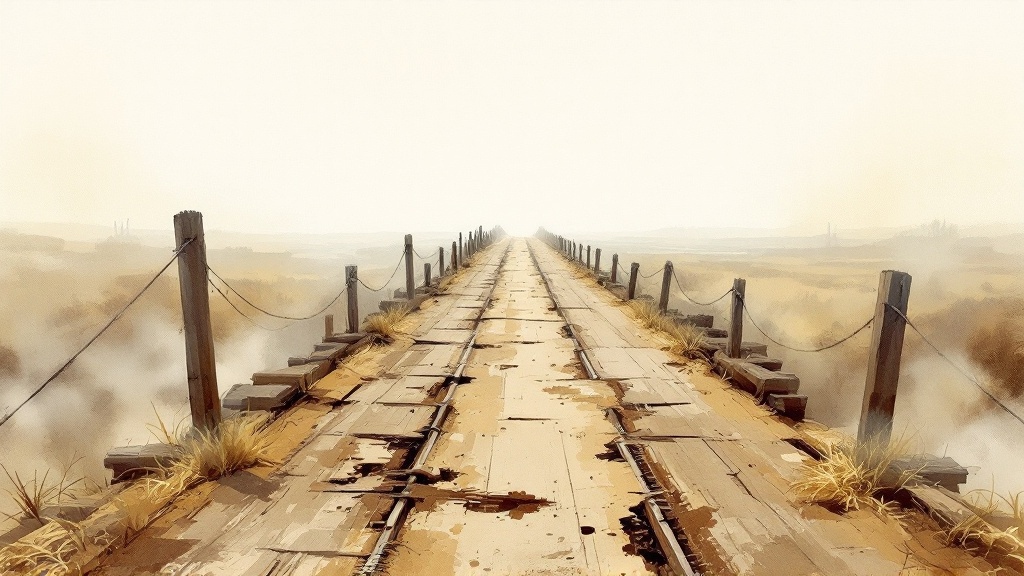
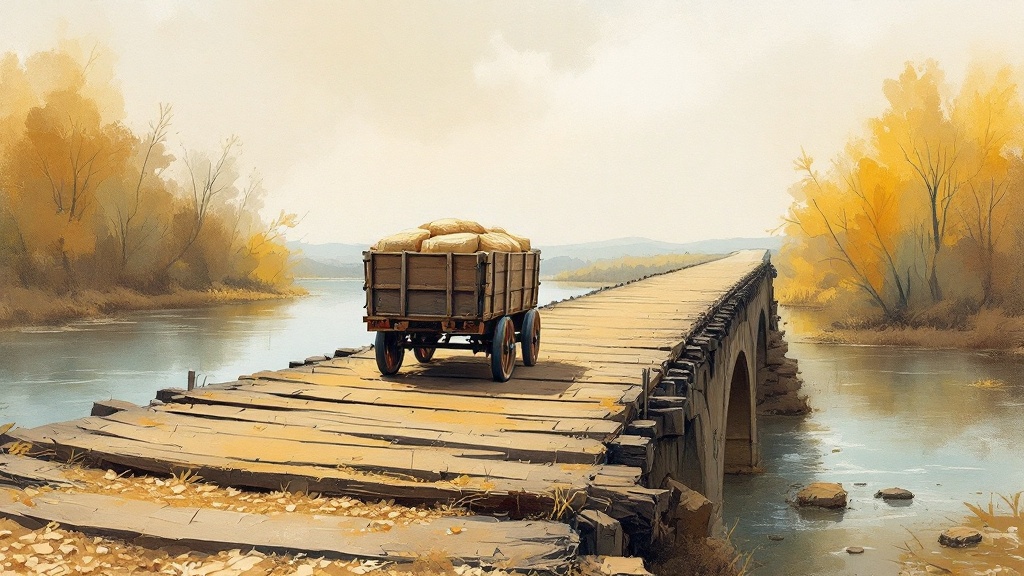
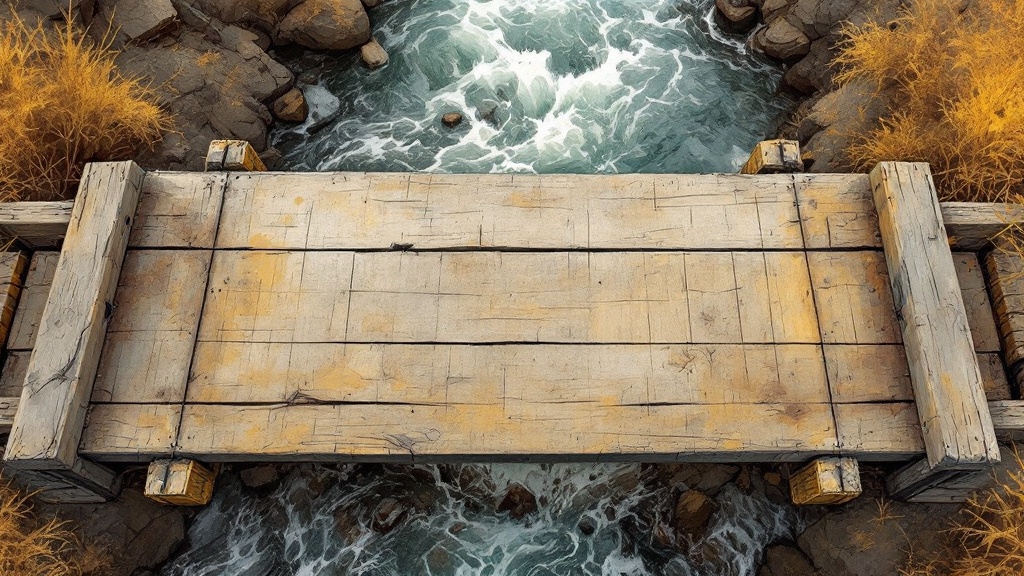
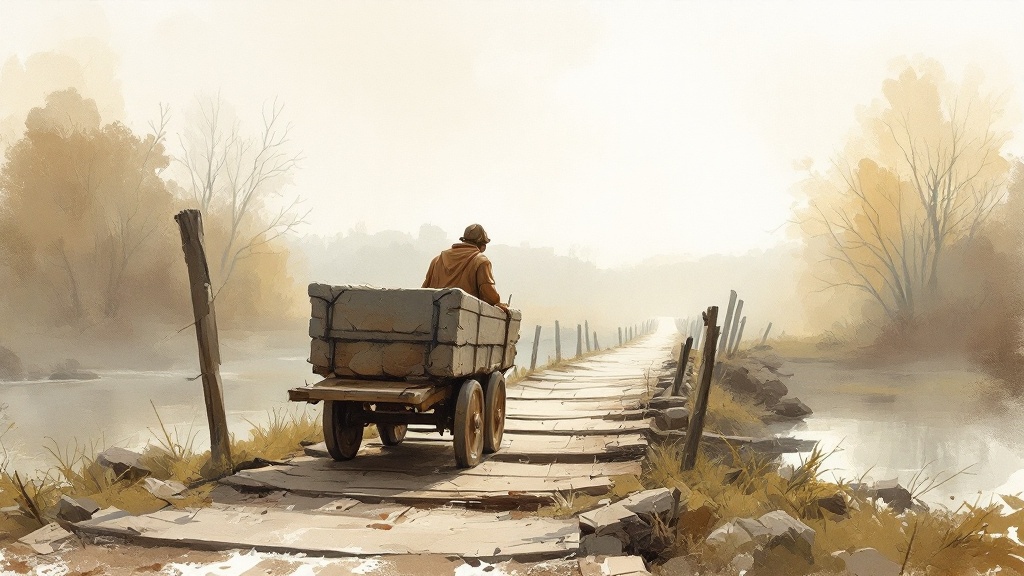
The bridge was young. Rough-cut timber planks lay slightly uneven underfoot, narrow enough that two travelers had to turn sideways to pass each other. Below, the river moved clear and slow over smooth stones, and through the gaps between boards, the light of the water flickered up.
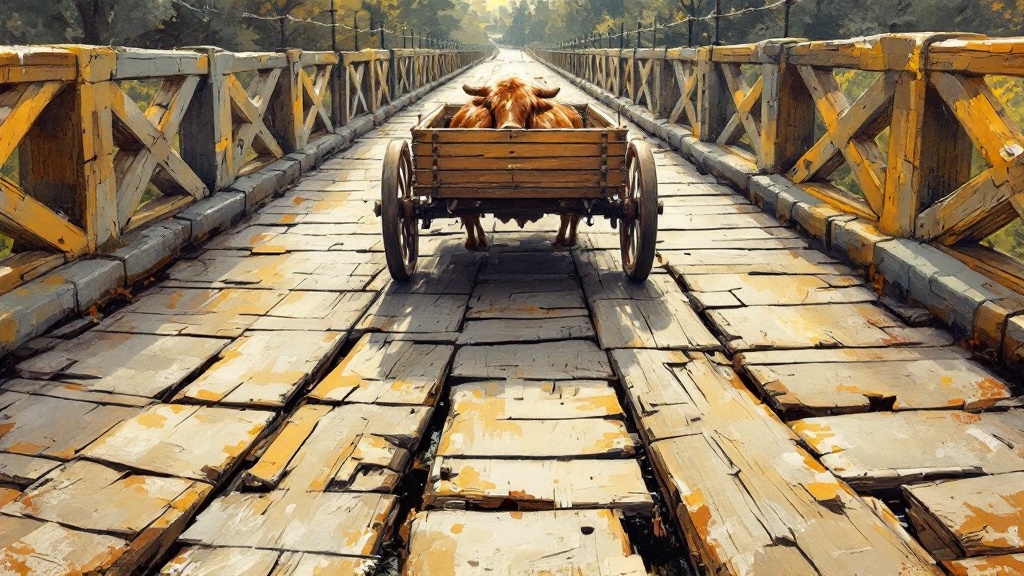
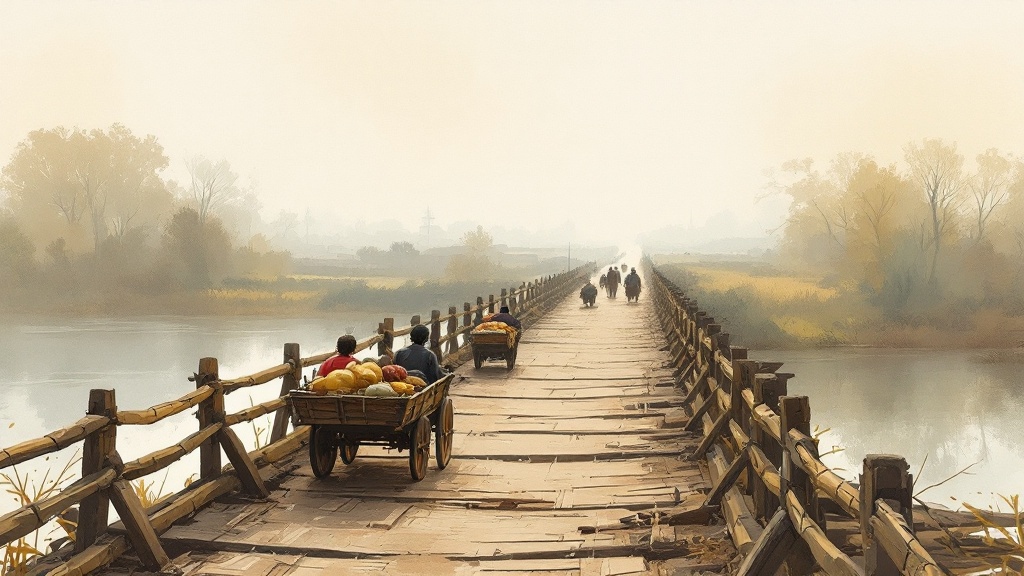
In the morning, a woman crossed with a clay pot balanced on her head. Two children chased each other from one bank to the other, bare feet knocking hollow on the wood. At midday, an ox-cart crossed, the driver clicking his tongue at the animal. The planks gave a single sustained groan beneath the wheels, then went quiet again.
Then the old man came.
He paused at the center. His walking stick found the wood. The water moved below. That was all.
He stood there a while, weight settled on the stick, looking down at the river running under the planks. The bridge held him without effort. Neither of them was thinking about it.
When evening came, the bridge had carried perhaps a dozen crossings. The river moved on as it had moved. The bridge stood unchanged.
That was the first day.
Beat 2: The seasons turn, traffic increases
The seasons turned.
New families came to settle on both banks. A grain merchant established a regular route. Then a second merchant, trading in cloth. Market days expanded from one day a week to three.
More wagons. More merchants. More mornings with feet on the planks before sunrise. More evenings with crossings after the sun had gone. The bridge that had carried a dozen crossings in a day now carried that many before midmorning, and more by night.
Through it all, the bridge worked. It held what was placed on it. It made the same hollow knock under boot heels, the same low creak under wheels. Nothing announced itself.
But the wood remembered.
The center planks began to wear smooth and pale under the constant press of feet and hooves and wheels — a soft polish at the heart of the crossing. The outer edges still showed the rough grain of the original cut timber, untouched. Two textures lay side by side: what had been carried, and what had not.
No single crossing was unusual. The increase was steady and unremarkable, week by week. The merchants did not mark it. The villagers did not mark it. The bridge did not mark it.
The world was simply becoming larger than it had been.
Beat 3: The stone merchants come
Then came the stone merchants.
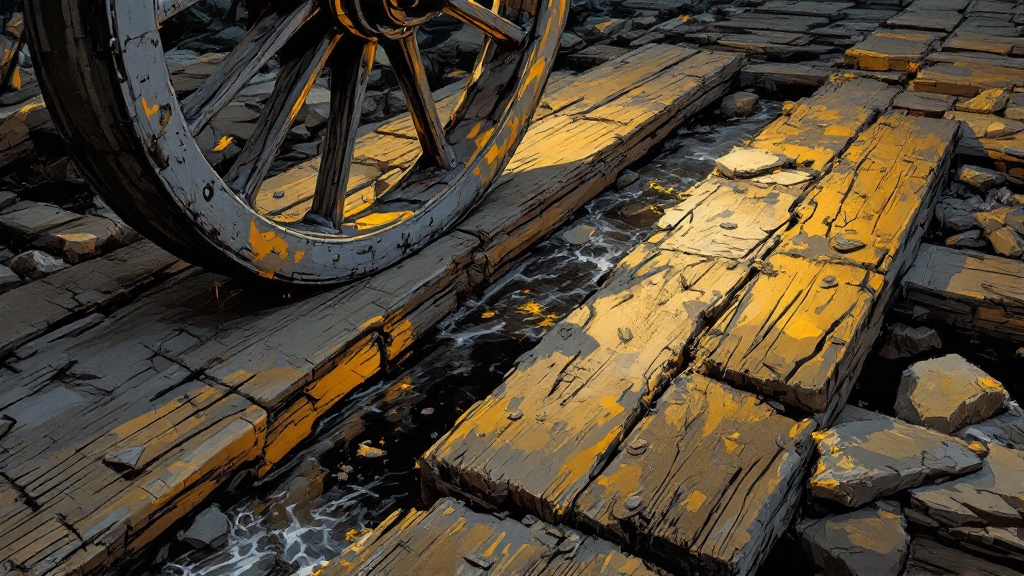
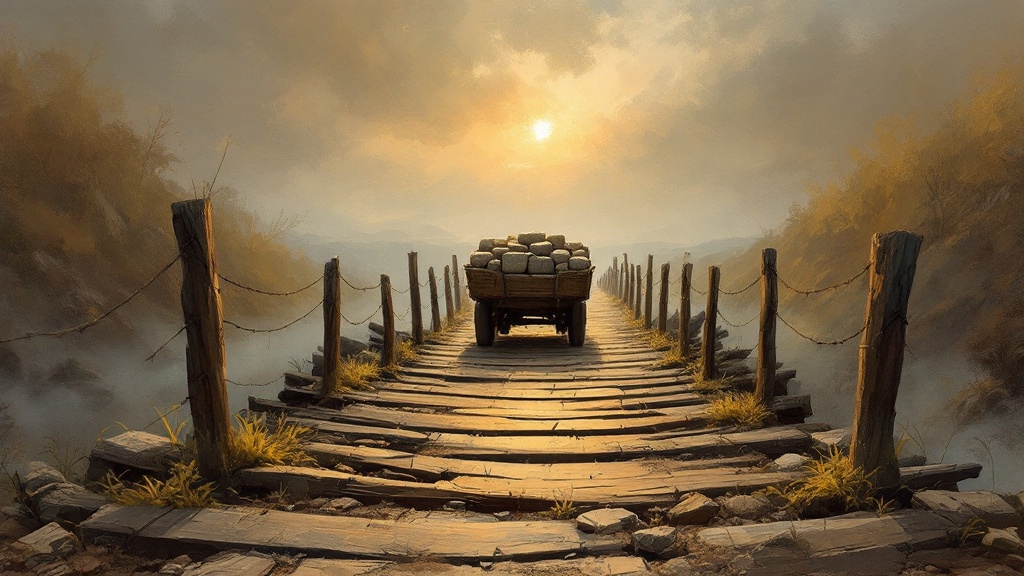
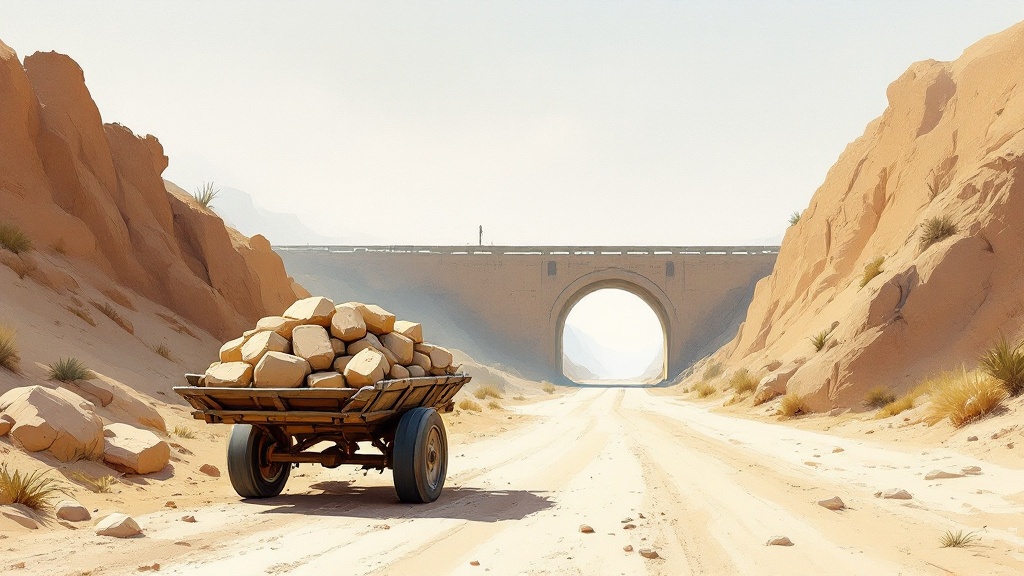
The first arrived with a cart loaded heavier than any wagon the bridge had carried before. His wheels pressed deeper into the planks than the grain wagons had. The bridge made a sound it had not made before — a lower, longer creak that did not end when the cart passed but lingered a moment in the wood.
A second stone merchant followed the route the first had opened. Then a third.
And the crossings began to happen at night.
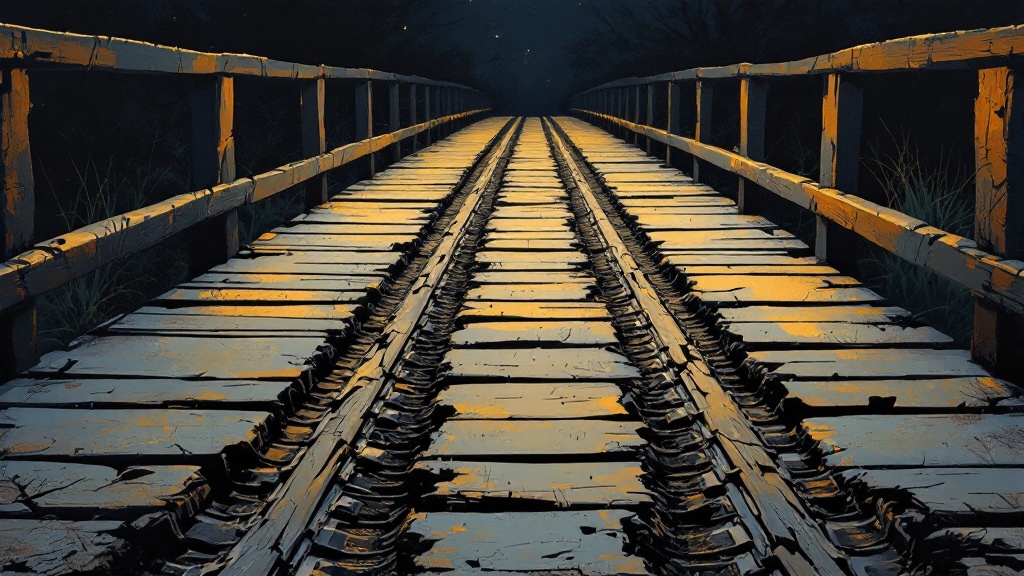
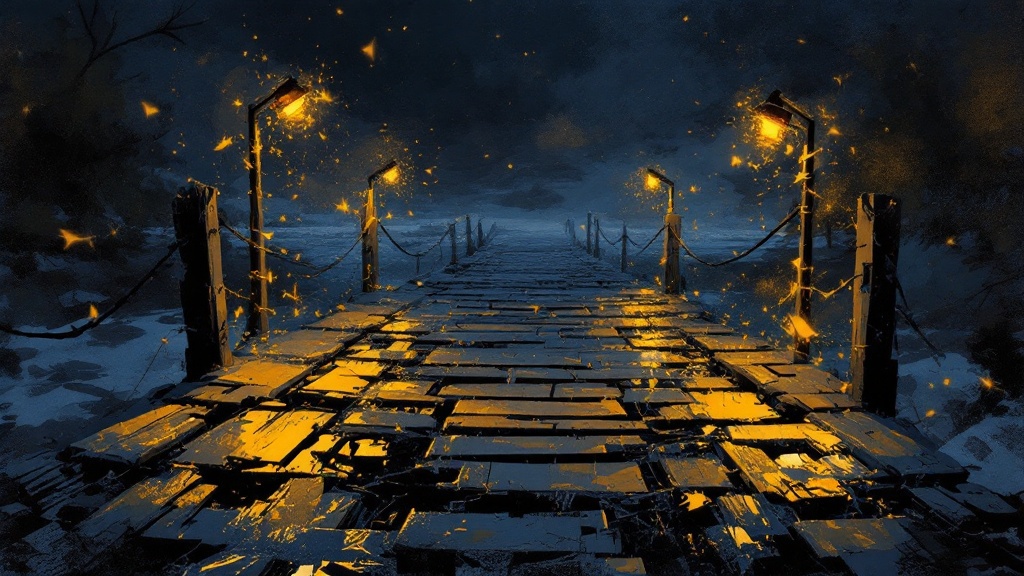
Torches now crossed in the dark, their reflections broken on the river below. Where once the bridge had stood quiet between sunset and dawn, now it carried weight in both directions through the hours when the world used to rest.
Once the bridge had rested between crossings. The wood had settled. The planks had returned to their shape.
Now the weight arrived before the wood had answered the last weight.
And the accommodating became the story. Each crossing, on its own, was manageable. The stone merchants were not careless. The carts were not unreasonable. The bridge accommodated each one because each one could be accommodated.
But the accommodating did not stop.
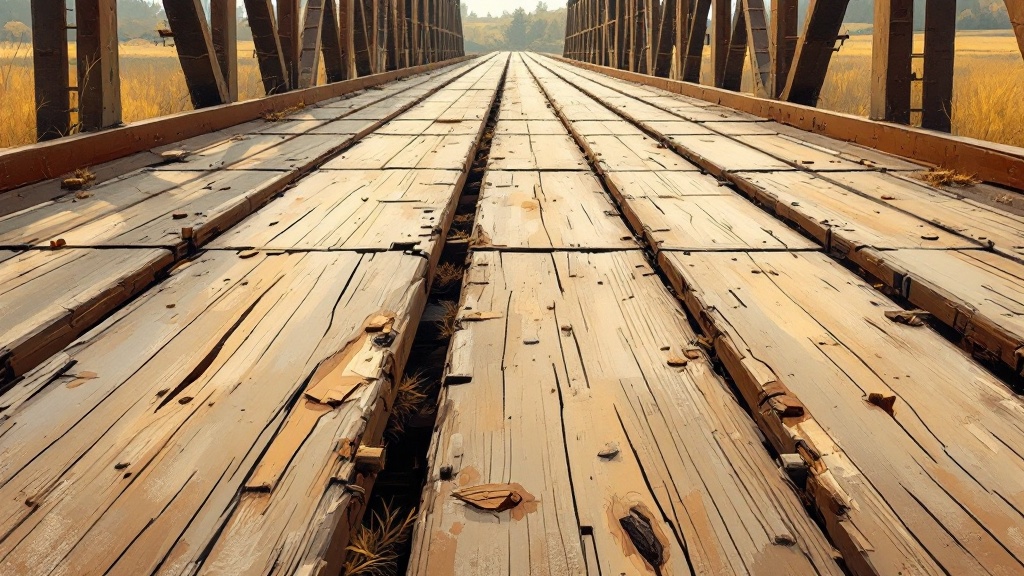
Wheel ruts pressed deeper into the center planks. Fine cracks opened in the railings where none had been before. The planks beneath the heaviest loads began to compact — not flex, compact — losing the give that healthy wood is meant to have.
The bridge could not see this. The bridge had no way to see this. It only knew that weight came, and weight went, and weight came again before the last weight had finished going.
The merchants saw the torches crossing in the dark and called it prosperity.
It was prosperity.
It was also something else.
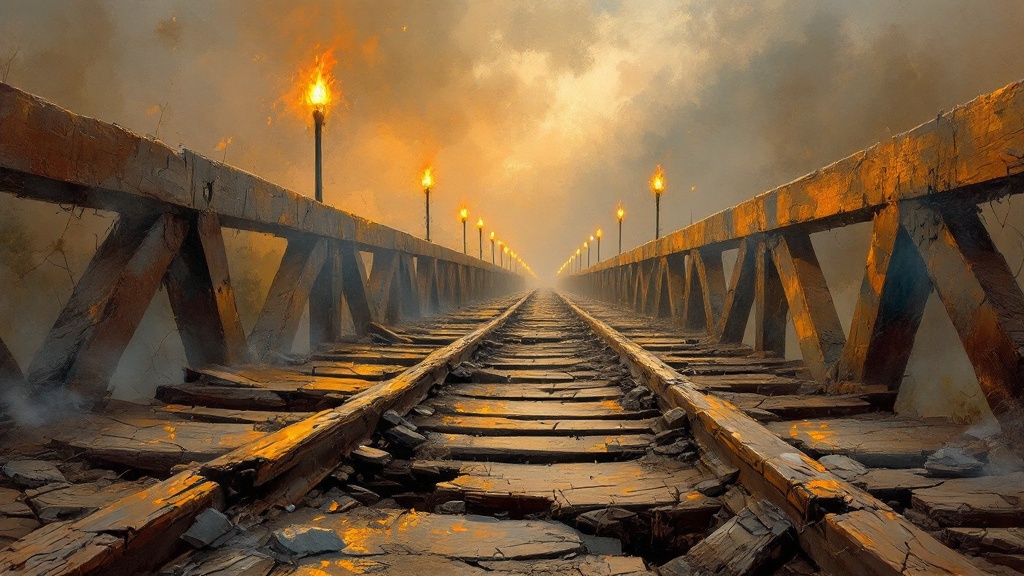
Beat 4: Strain emerges, invisible beneath
One week, the bridge carried more than it had carried in any week before.
Stone carts in the morning. Grain wagons through the afternoon. Cattle drives in the evening. None of it remarkable. All of it, together, the densest accumulation the bridge had yet known.
Midweek, a driver brought his cart to the center of the span and stopped to adjust a slipped harness strap.
He stood there longer than usual. Perhaps three minutes. The cart did not move. The ox shifted its weight from one side to the other. The driver bent over the strap, talking low to the animal. The bridge held the stationary load without visible trouble. The planks did not groan. The railings did not shift.
The driver finished. He clicked his tongue. The cart moved on.
That evening, the bridge looked the same as it had in the morning. A dozen wagons had crossed. A herd of cattle had crossed. The driver had stood at the center for three minutes and the bridge had held him.
The bridge knew itself, in its way. It had carried what came. It had not failed. Purpose felt like sufficiency. Each crossing answered. Each load received. The bridge could not see its own foundations. No structure can.
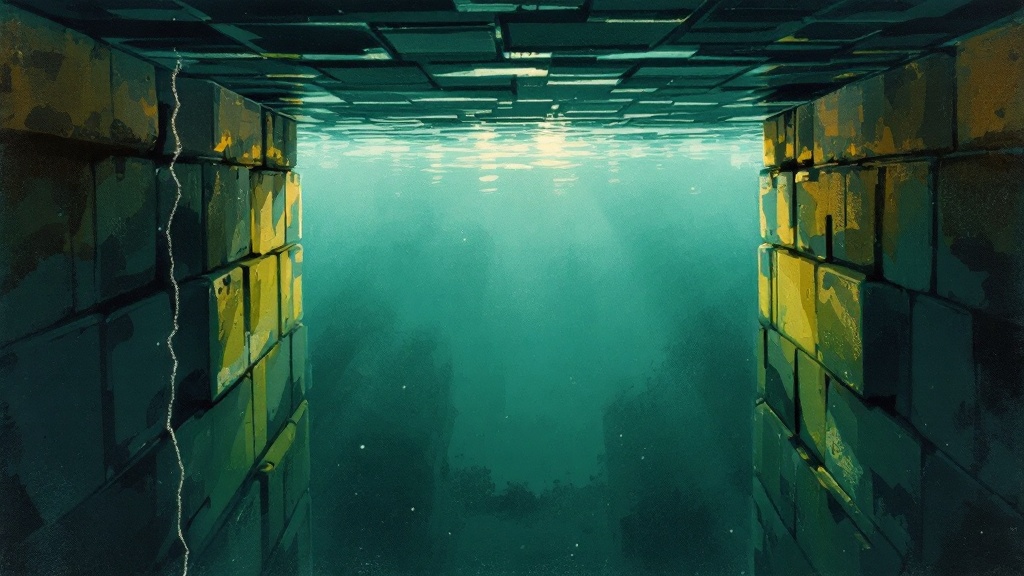
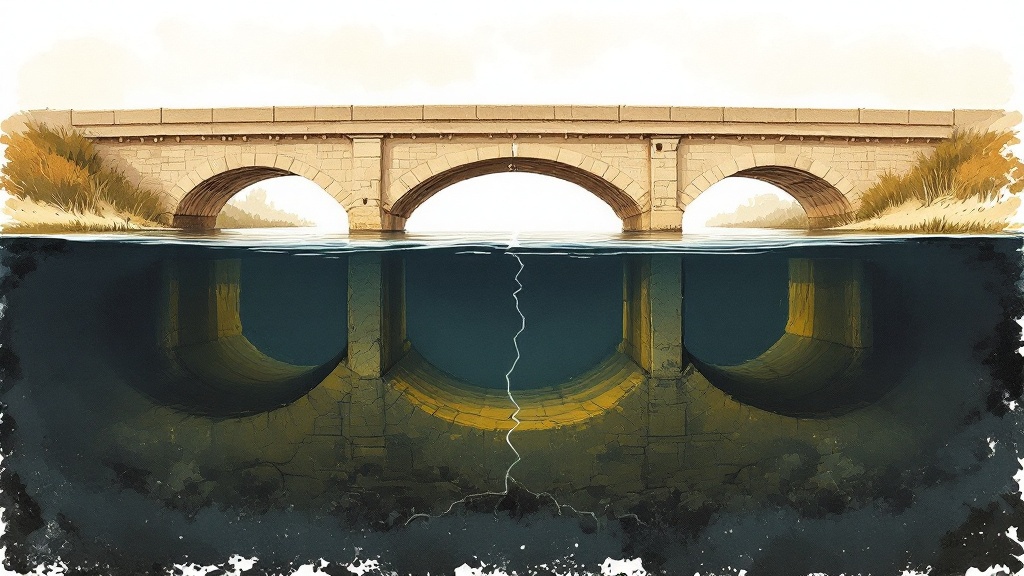
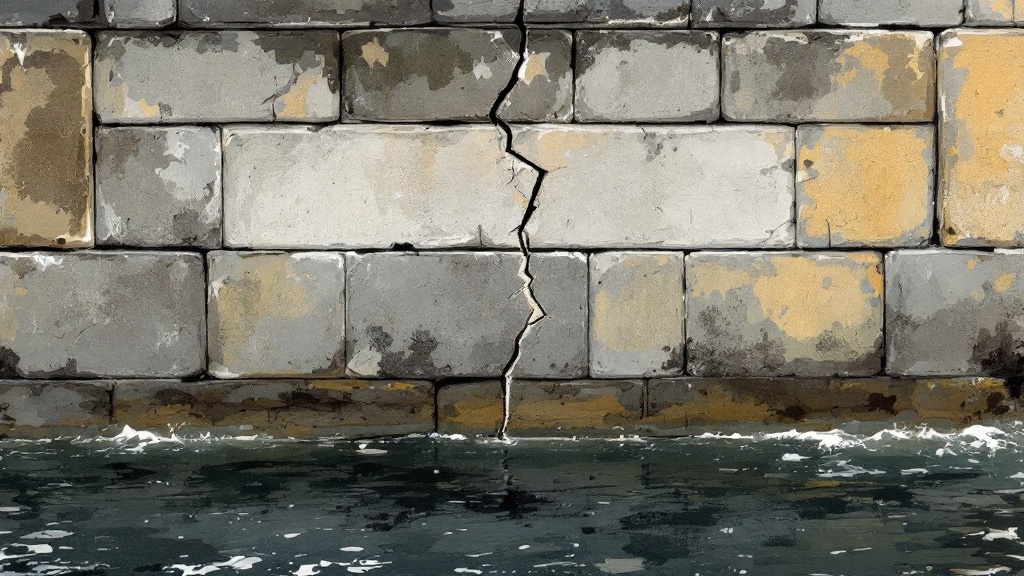
Below the waterline, in the dark beneath the south pier, the mortar between two courses of stone had begun to separate.
A thin line. Pale gray against darker stone. Running along the join where two foundation blocks met. Invisible from above. Invisible from the deck. Invisible to the driver who had stood at the center for three minutes while the weight pressed down.
Above: a bridge unchanged.
Below: a crack opened.
Both at the same moment. Both true.
Beat 5: The crack does not close
The crack did not close.
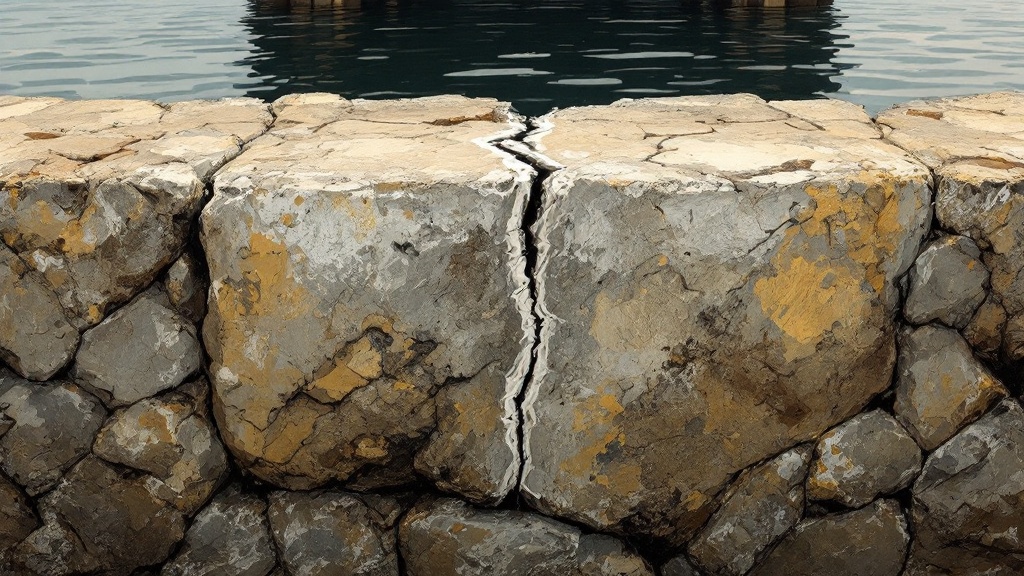
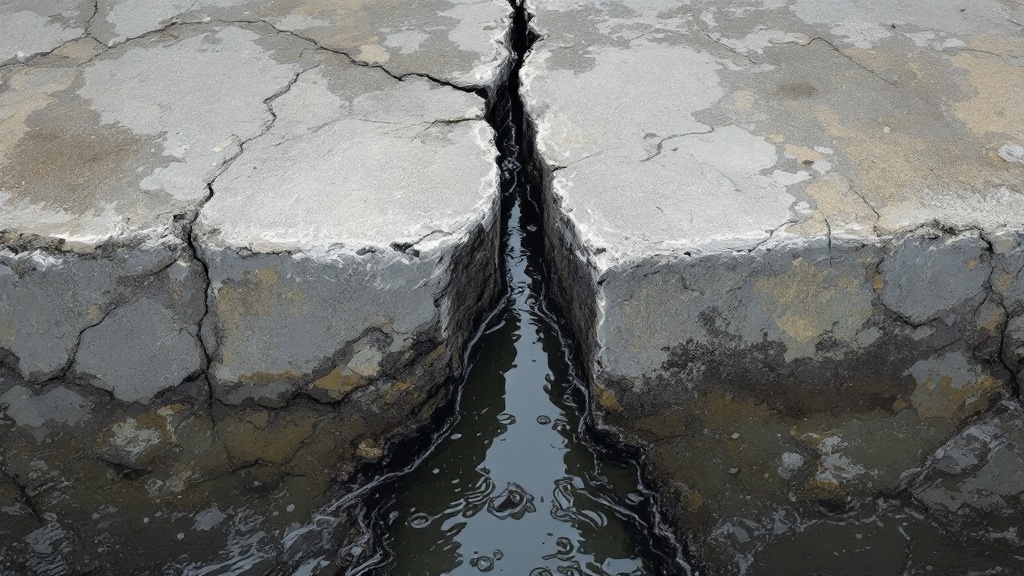
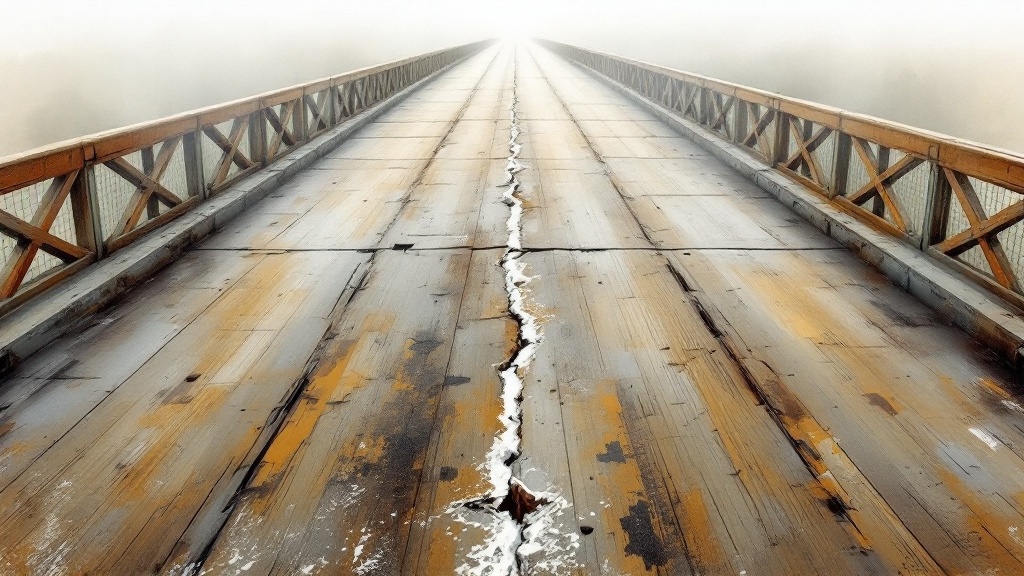
In the weeks that followed, it widened — not by a width any eye would catch from one day to the next, but by a width a finger laid in it would confirm from one month to the next. The mortar gave up its hold slowly. The stone above it shifted by the smallest measure. The river kept on as the river keeps on.
A second crack opened, smaller, higher on the north pier.
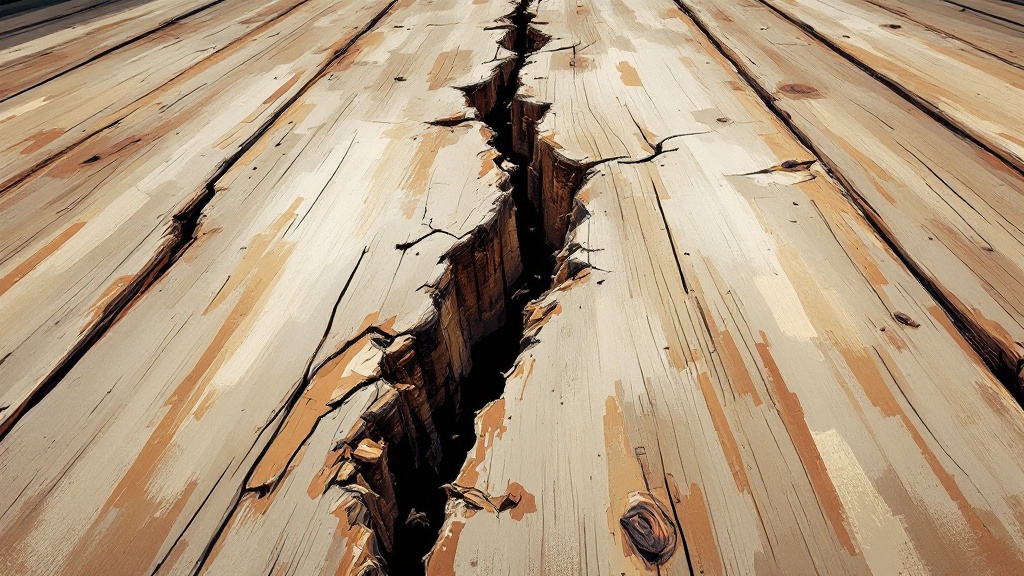
On the deck, three planks began to yield differently underfoot — a soft wrongness in the wood, the kind of give that is not flex but rot beginning beneath the surface. A finger pressed into them came away with the faintest darkness.
The cattle were heavier this season. The traders who used the bridge were prosperous, and their carts were full. New goods crossed — pottery, iron tools, livestock from distant pastures. The weight of a single market morning now exceeded what the bridge had carried in an entire week during its first year.
After a rain, pale mineral dust settled into the line of the south pier crack — a thin white trace against the gray stone, plain to any eye that looked at the right level.
No eye looked at the right level.
Each individual crossing remained ordinary.
The bridge did not announce what was happening.
The river did not slow.
The weight did not wait.
Beat 6: The morning it fell
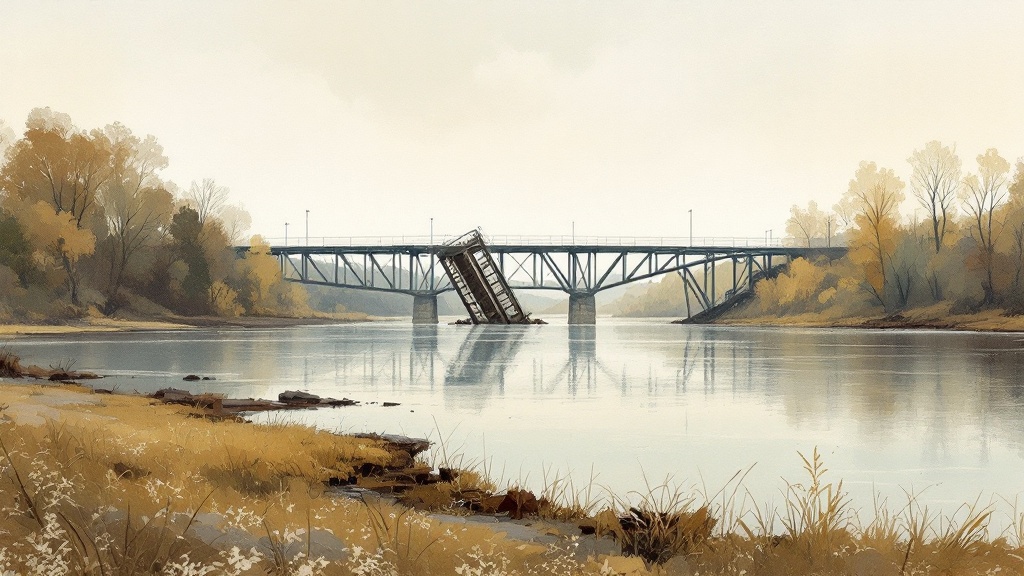
The morning it fell began like any morning.
A grain merchant brought his wagon to the south bank at midmorning. The wagon was full — the same full it had been many times before. The merchant had crossed this bridge in this season with this load more times than he could count. He clicked his tongue. The ox moved onto the planks.
The wagon reached the center of the span.
The bridge groaned.
Not loudly. Low, slow, sustained — like a door opening in another room. The merchant slowed his ox. Two villagers on the south bank lifted their heads. The groan deepened.
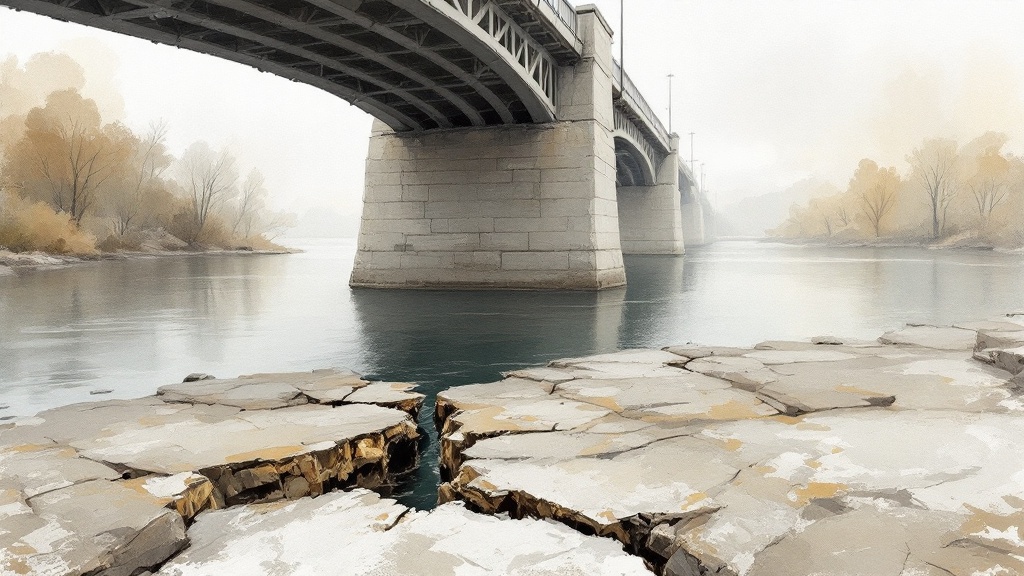
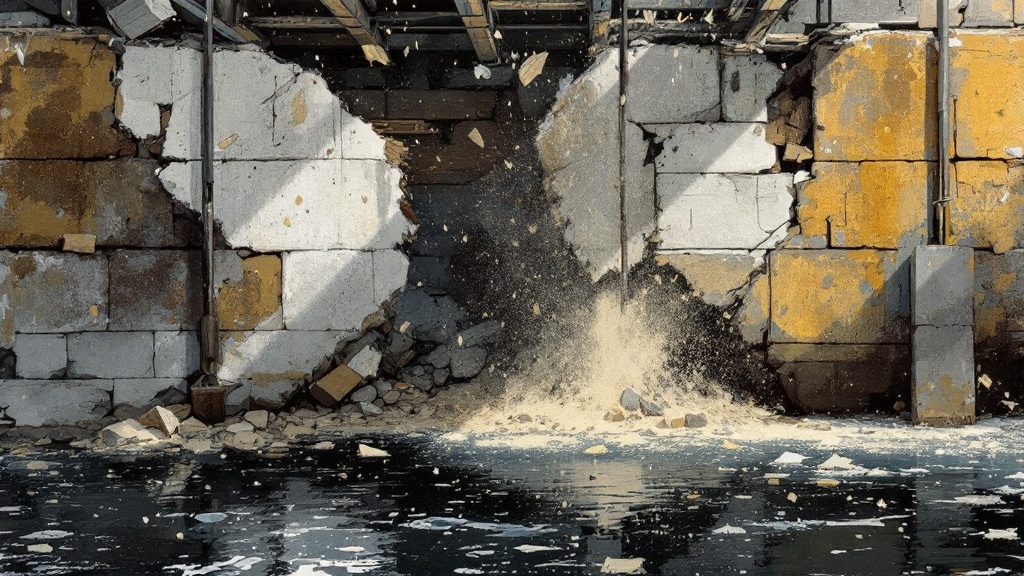
Then the mortar of the south pier gave.
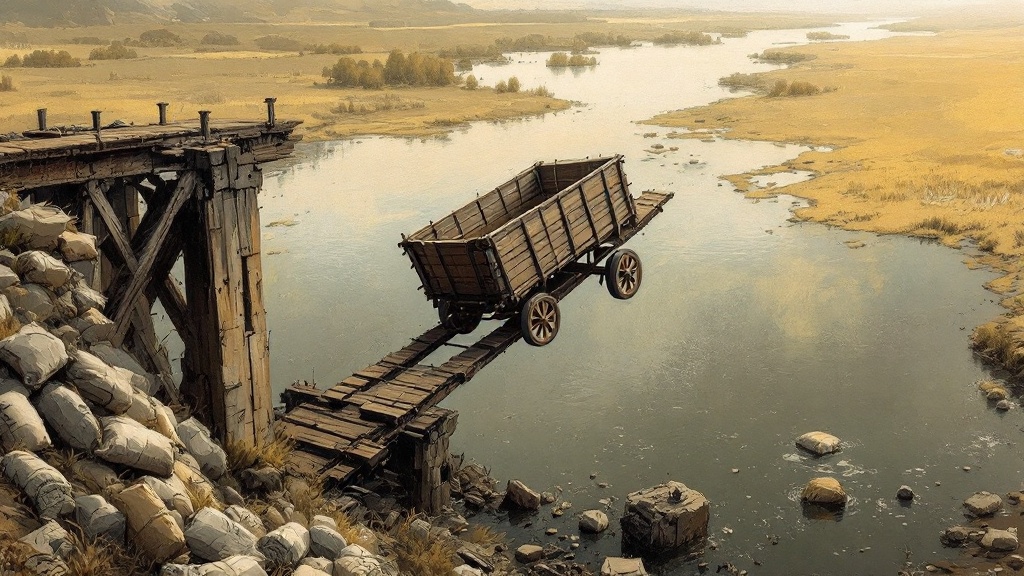
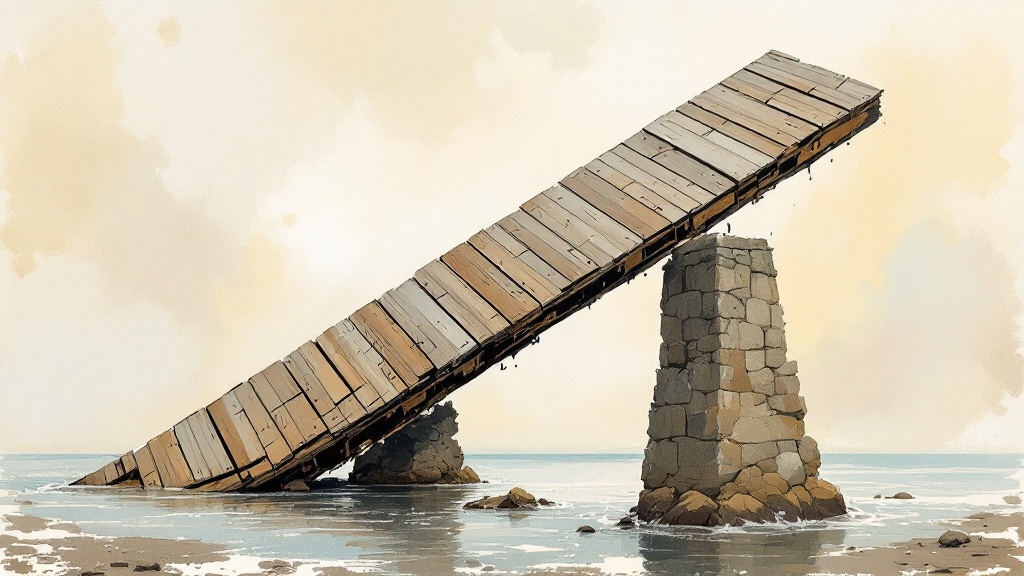
The deck dropped on the south side — a slow sitting-down, as if the bridge had decided to kneel. The wagon slid sideways. The ox lurched. The merchant's mouth opened, but sound had not yet found him.
For one held heartbeat the wagon hung at the tilt — one set of wheels still on the deck, the other side already over open air, the river dark and indifferent below.
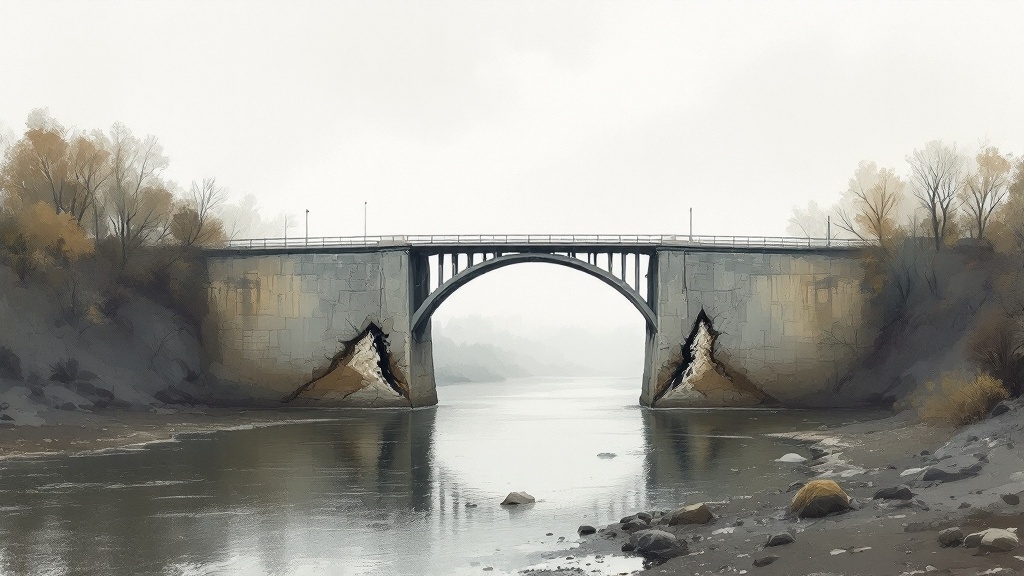
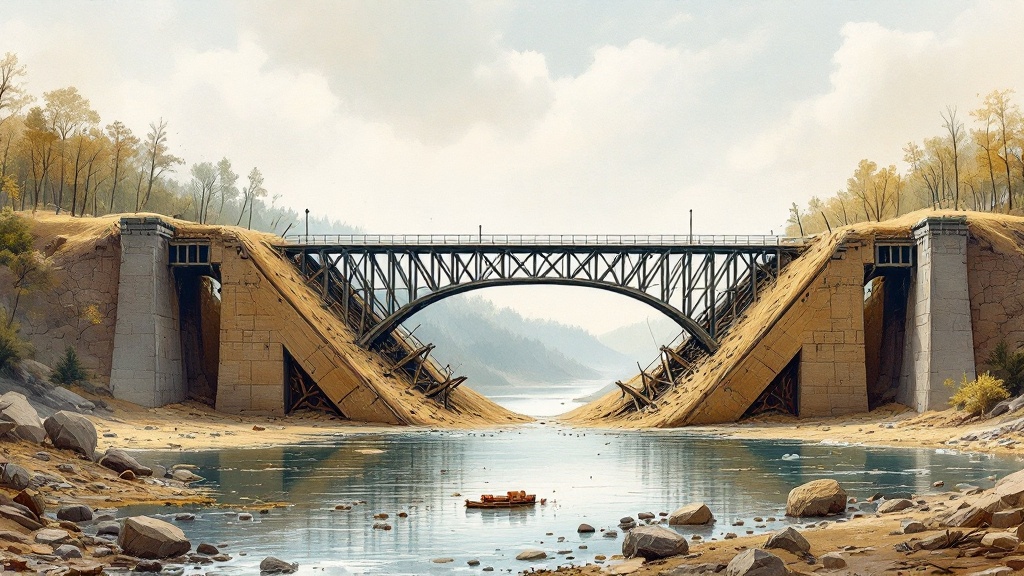
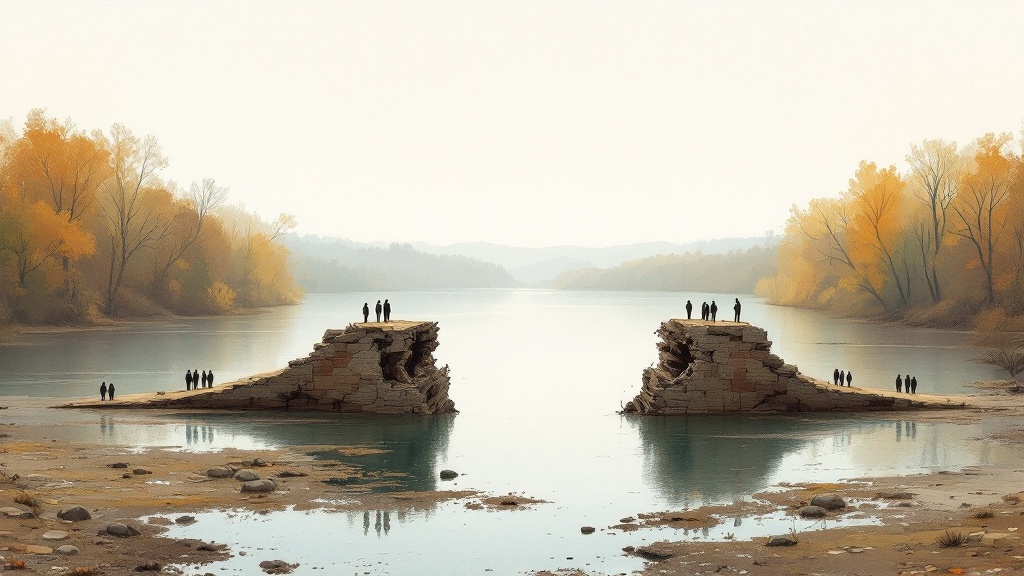
Then the north pier gave too, and the center folded down toward the water, both halves of the span collapsing inward.
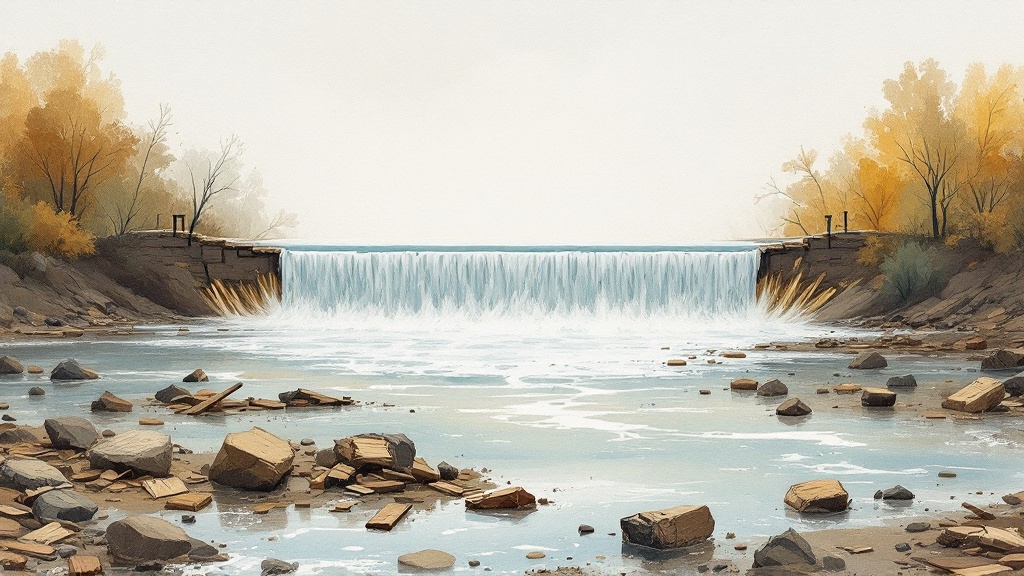
The wagon fell. The ox fell. The merchant fell. A flat sheet of displaced river rose and fell back. The crash carried to both villages and was heard by everyone who heard it.
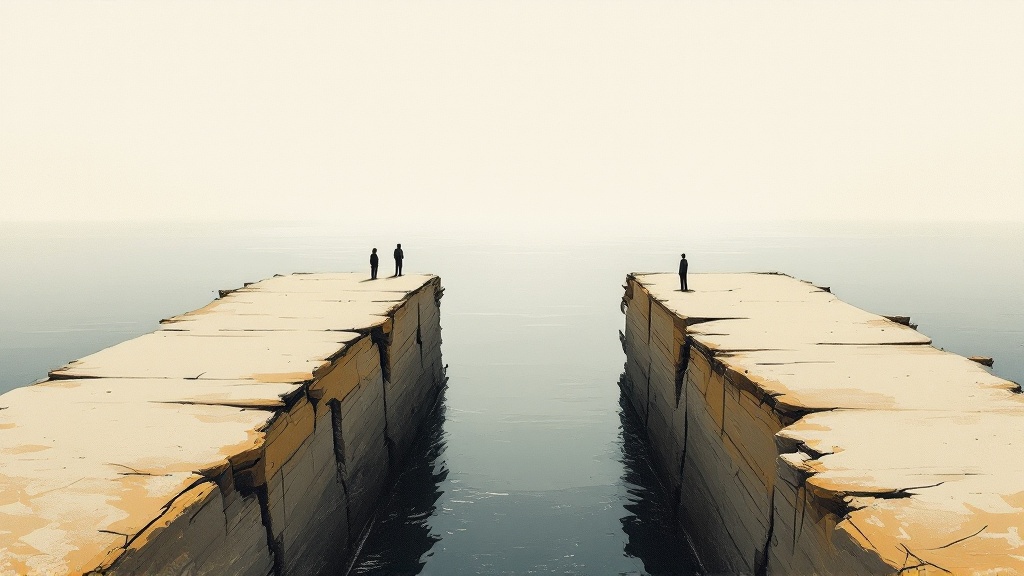
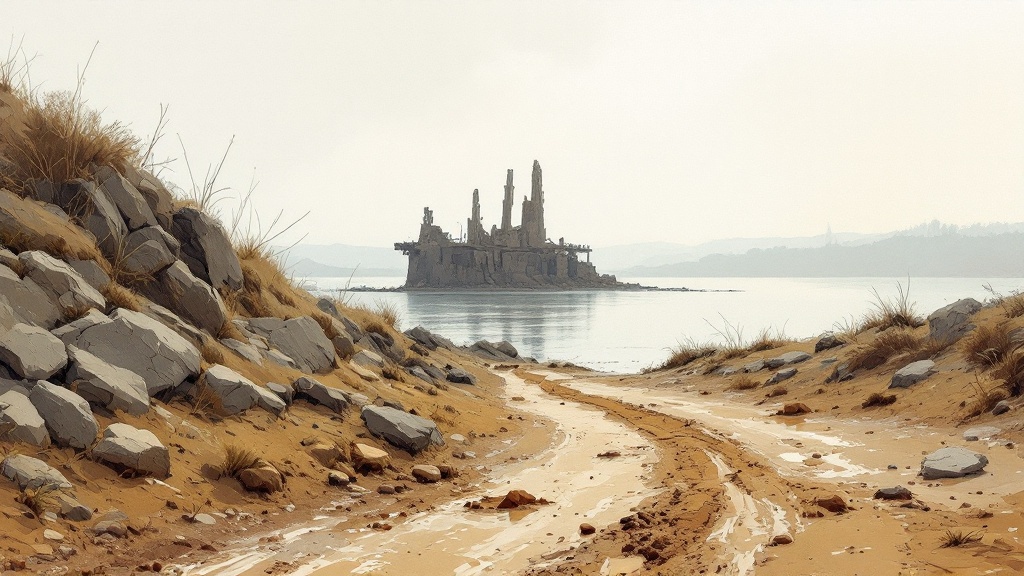
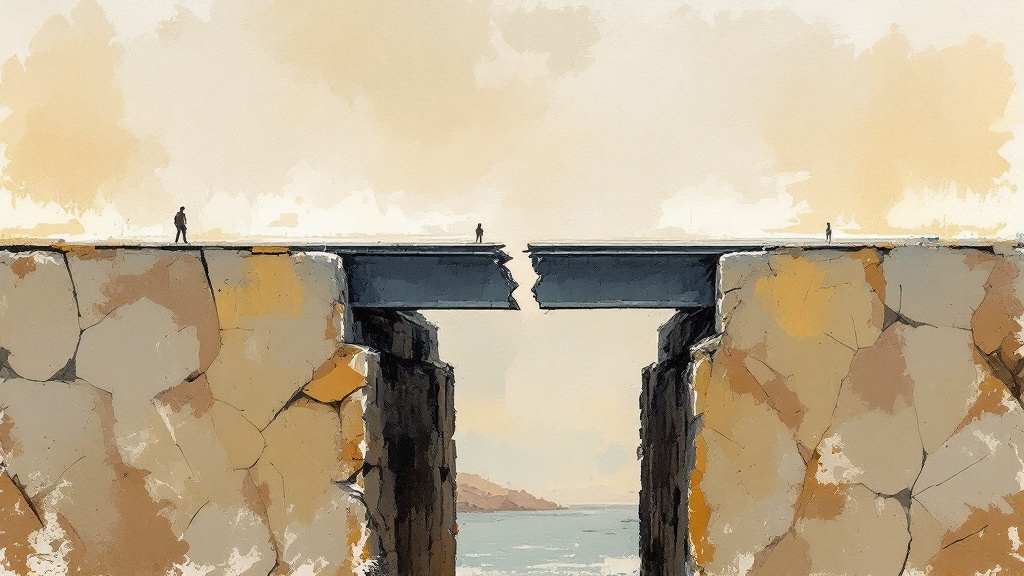
Then the silence. Not quiet — the river still moved — but the human sound stopped. The two banks stared across a gap that had not been there a minute before, with two ragged ends of deck pointing toward each other across the water.
The merchant surfaced downstream, clinging to a timber. The ox was lost. The crossing was gone.
Later, the villagers gathered on both banks and tried to say what had happened. The wagon had not been heavy beyond what he had carried before. The morning had not been unusual. The merchant had not been careless. The bridge had not been old.
Nothing had been wrong.
The merchant, dripping in the shallows, holding the timber, kept saying it to anyone who would listen: I did nothing different today. I did nothing different today.
He had not. The morning had not. The load had not.
The accounting had simply come due.
Beat 7: They went below
The crossing did not end the day the bridge fell.
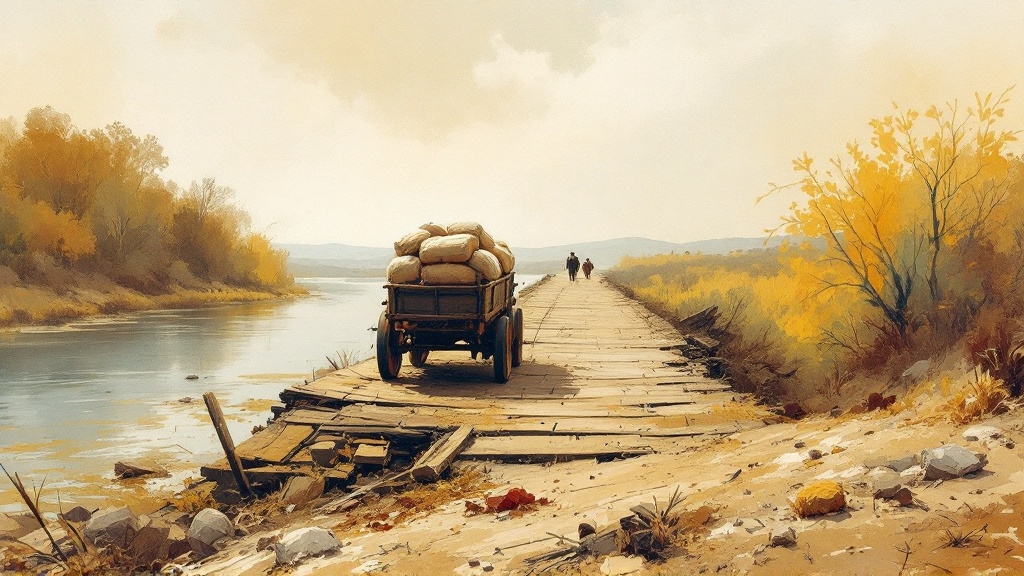
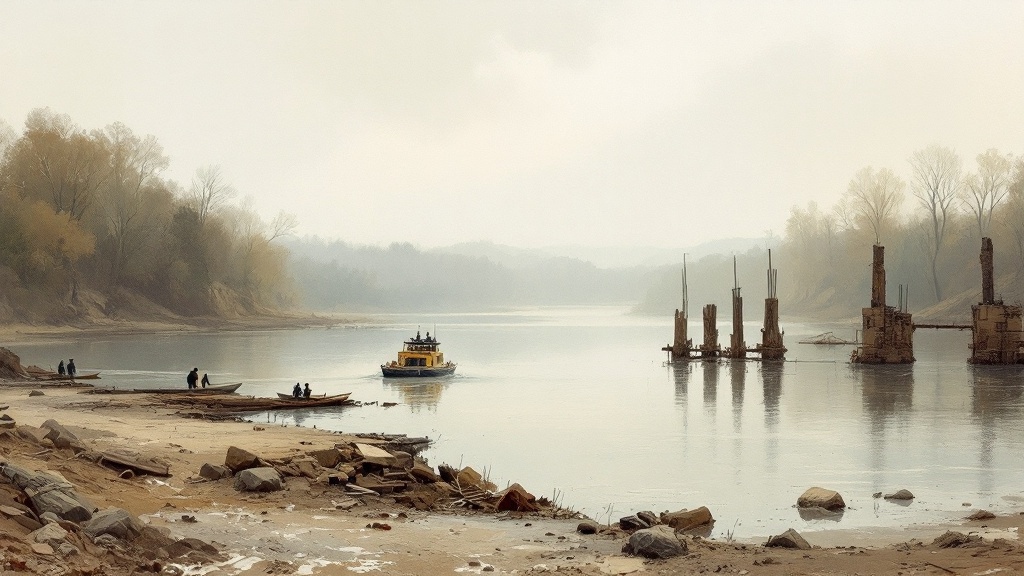
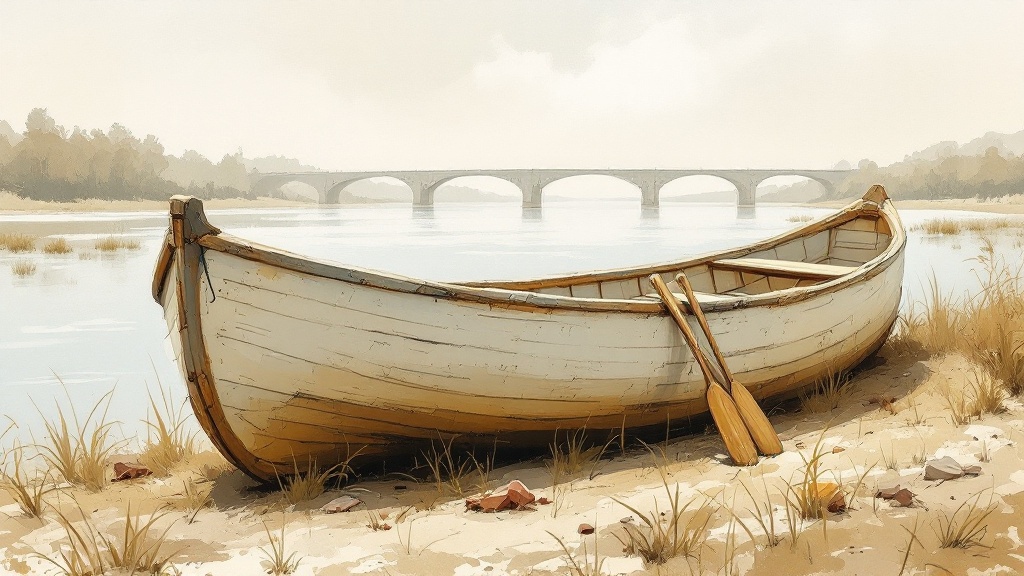
It slowed. Two men with a flat-bottomed boat began ferrying what could be ferried — slow, insufficient, the oars dipping and lifting against a current that did not care. The river carried the boat across. The villages stayed.
Word was sent for builders.
When the builders came, they did not begin where the bridge ended.
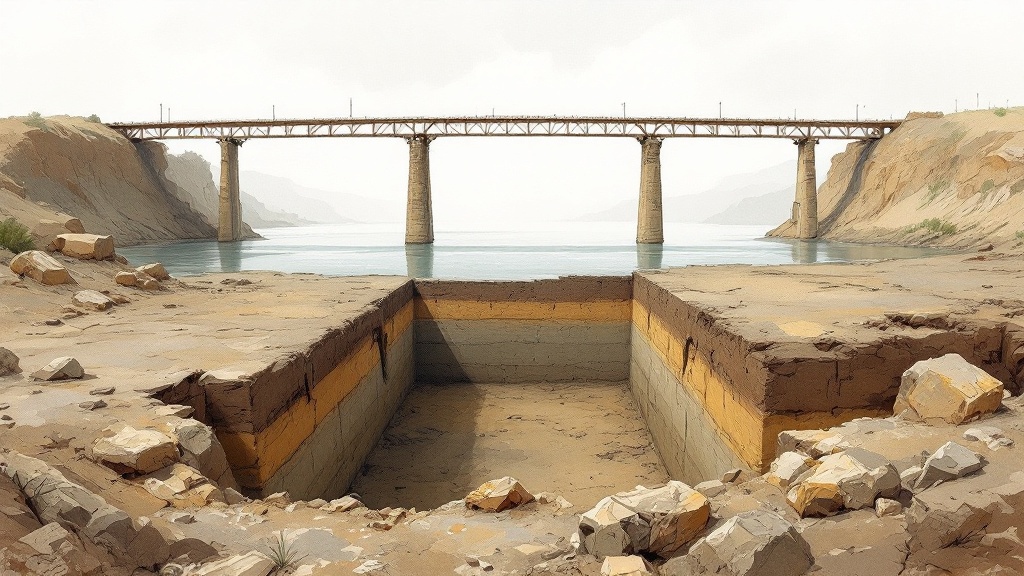
They went below.
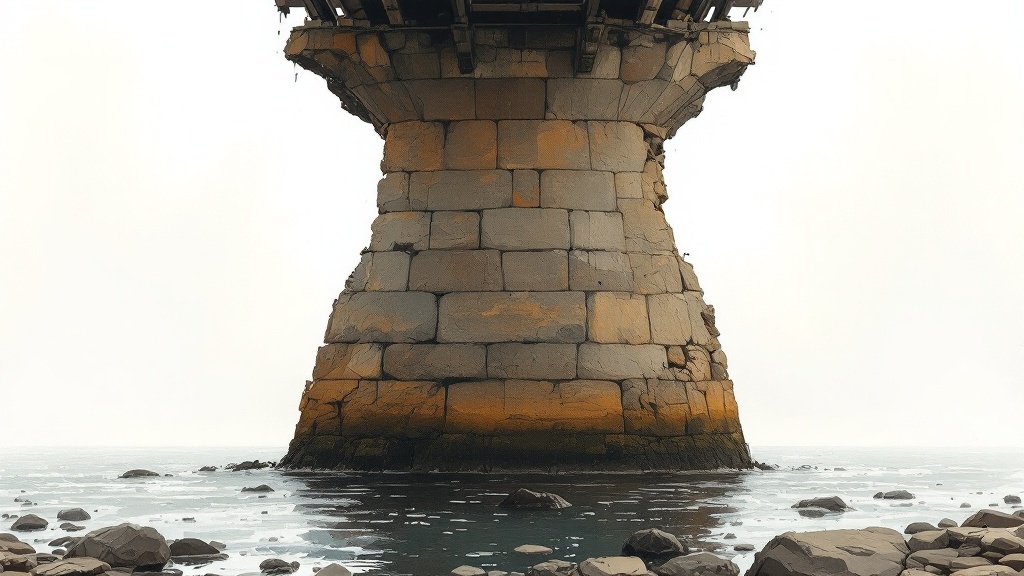
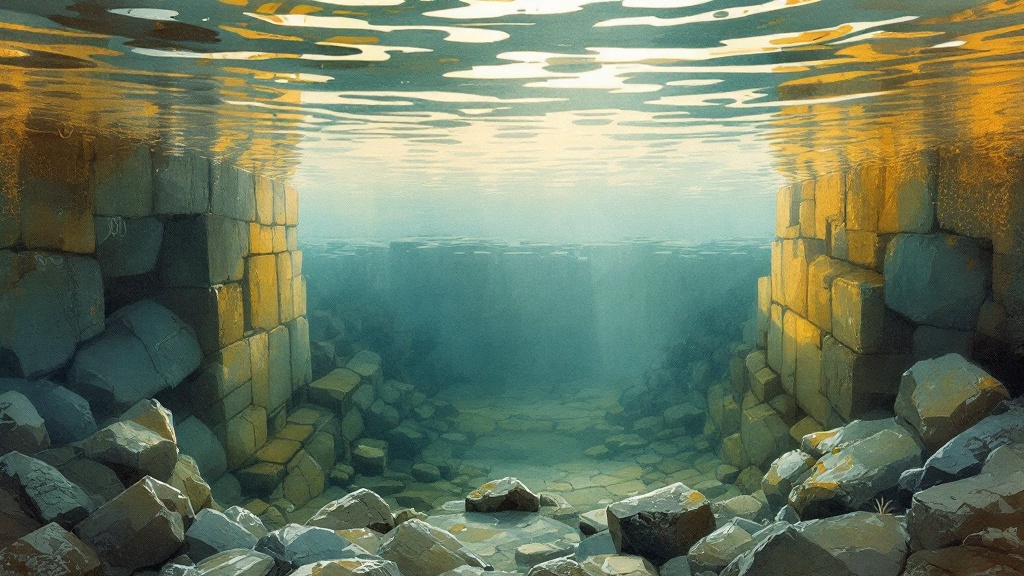
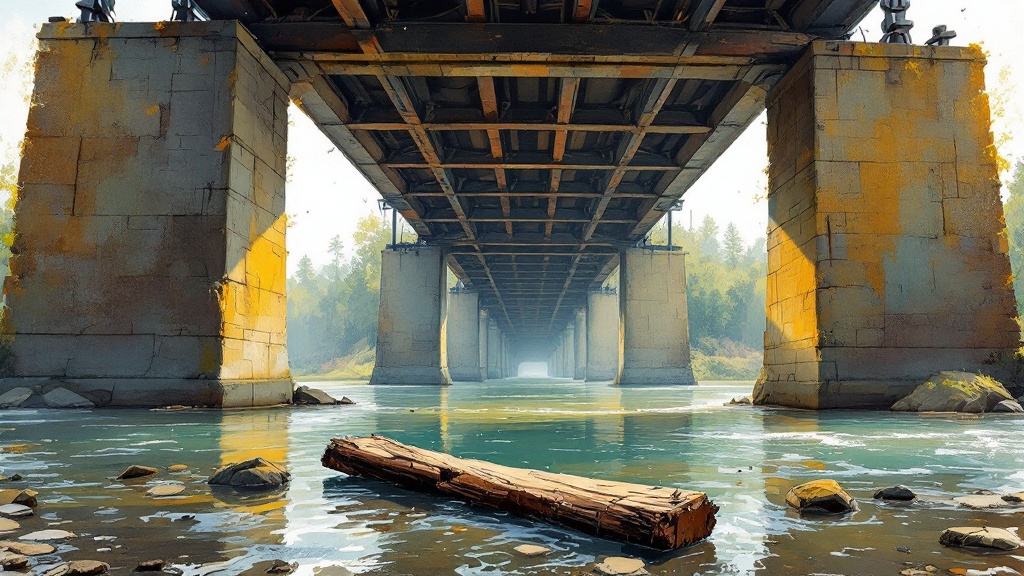
Divers entered the water — dark shapes beneath the surface, moving along the foundation line, hands finding the seams between stone and stone. They examined the south pier from its base. They examined the north pier from its base. They came up with pieces of the original footing in their hands, river water streaming off them, and held them out to the builders on the bank.
The truth was in the stone.
The original builders had not dug to bedrock. They had dug to a depth that had been right for the bridge they were building. They could not have known what the world would ask of that bridge in twenty years. No one could have known. They had built well for what they knew.
But the new builders knew more now. The river had told them.
They dug deeper.
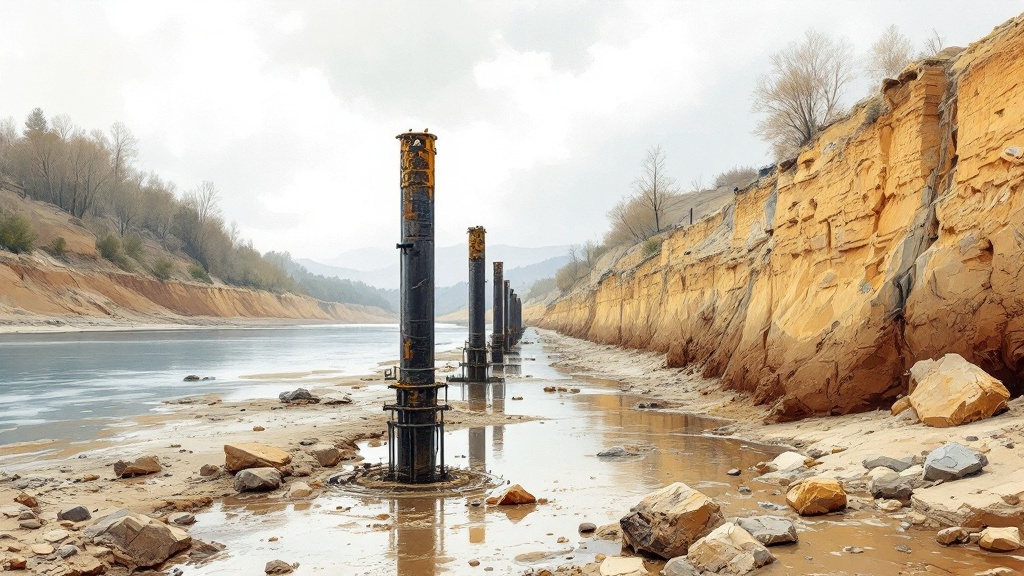
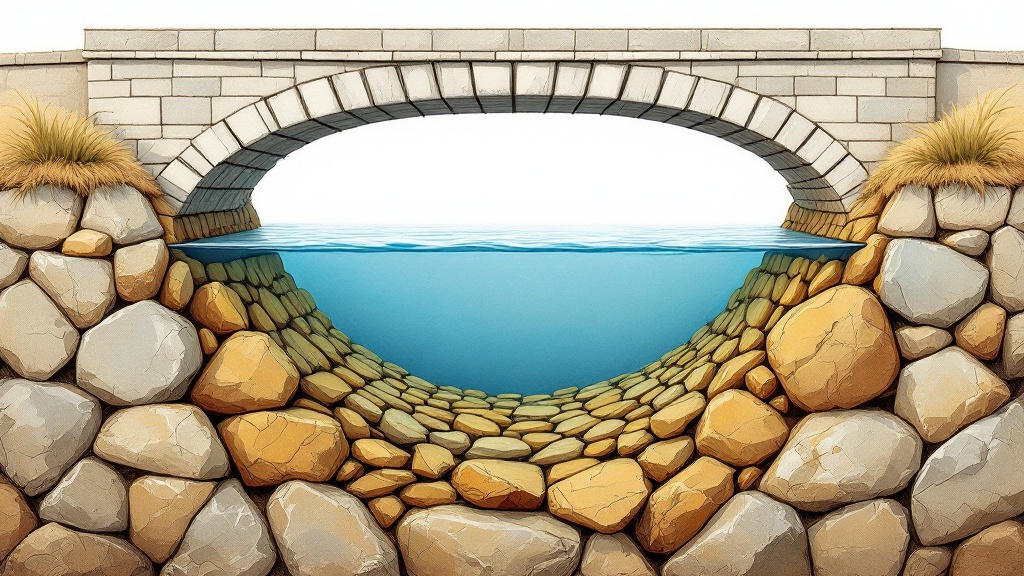
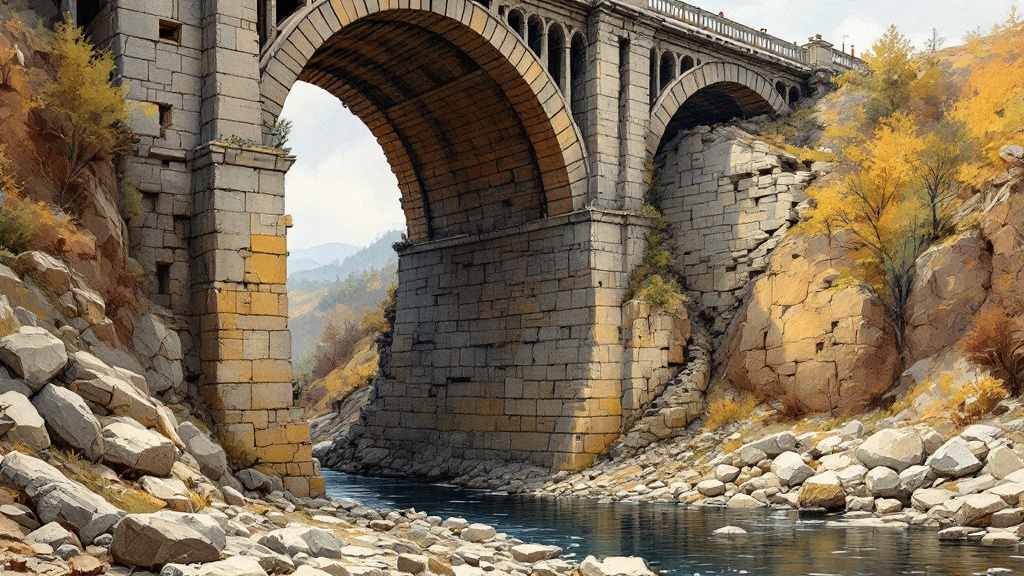
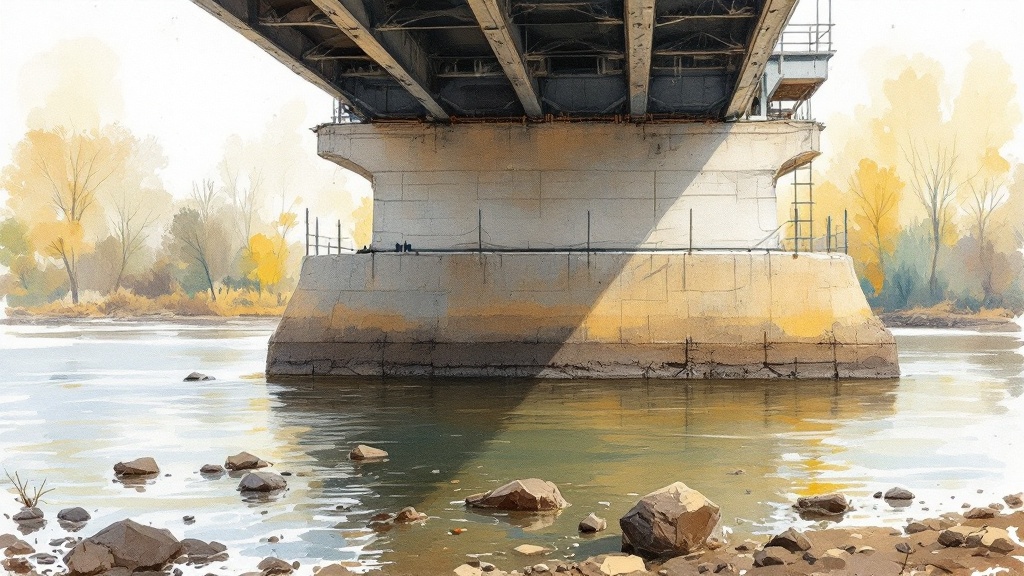
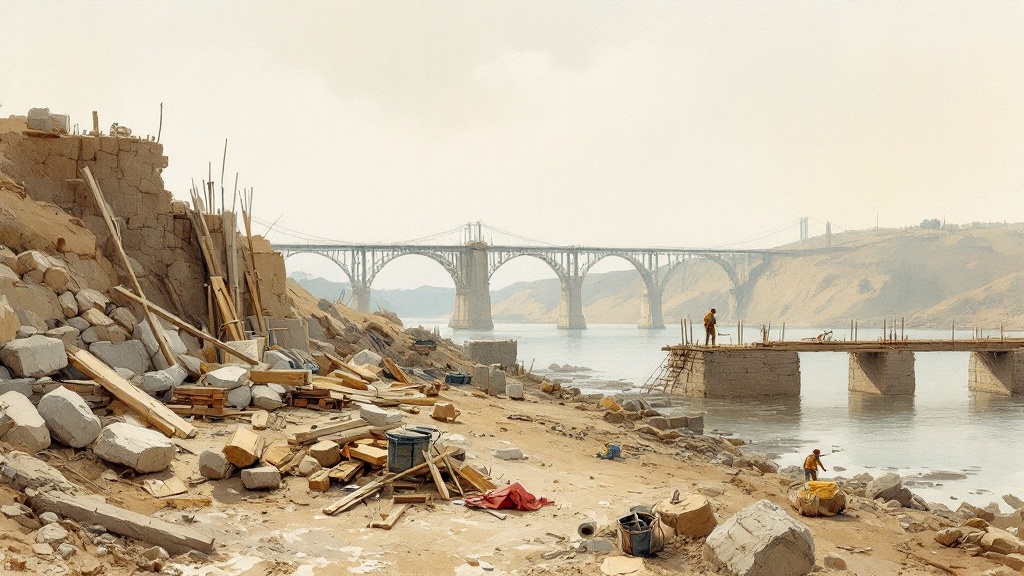
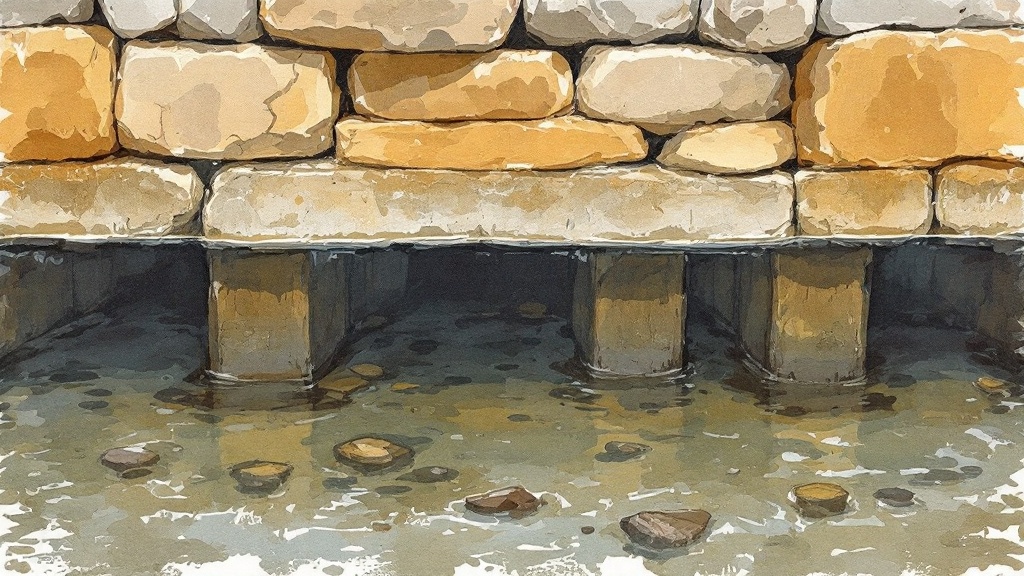
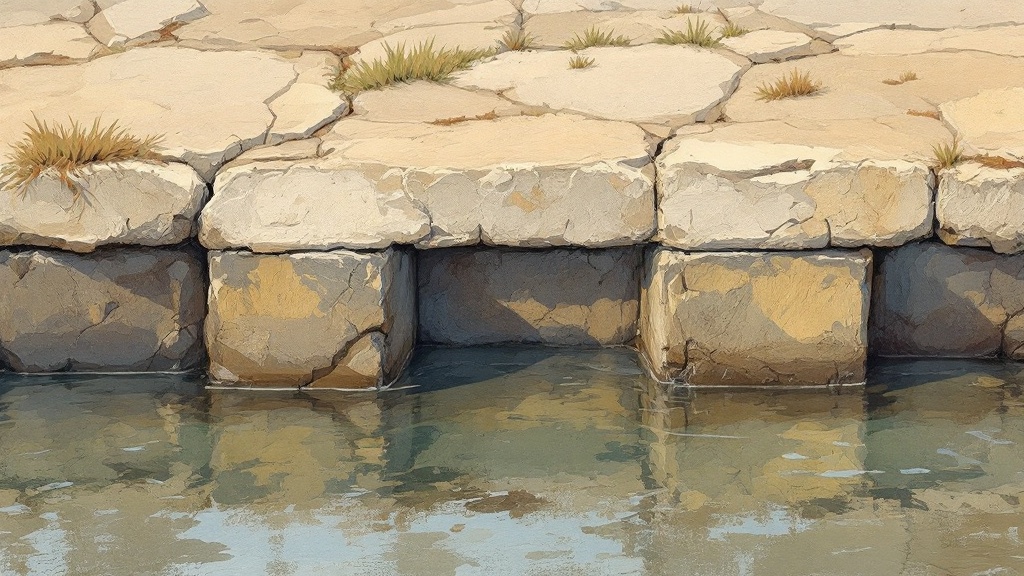
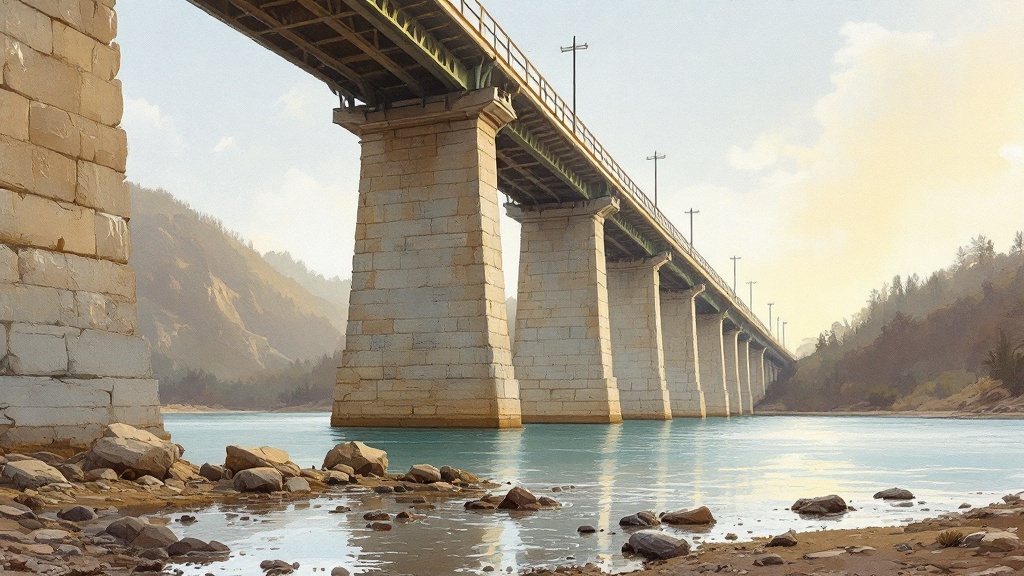
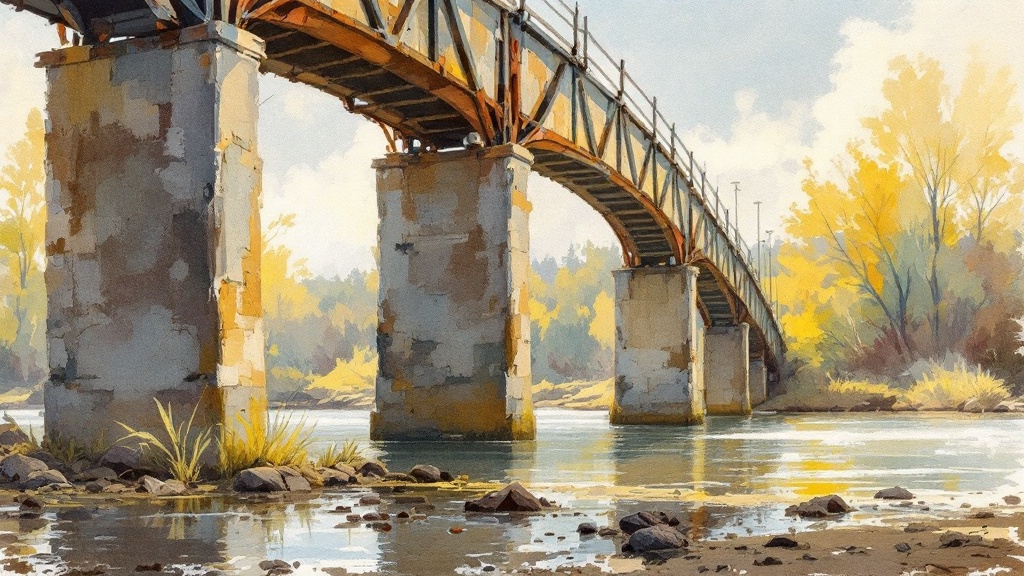
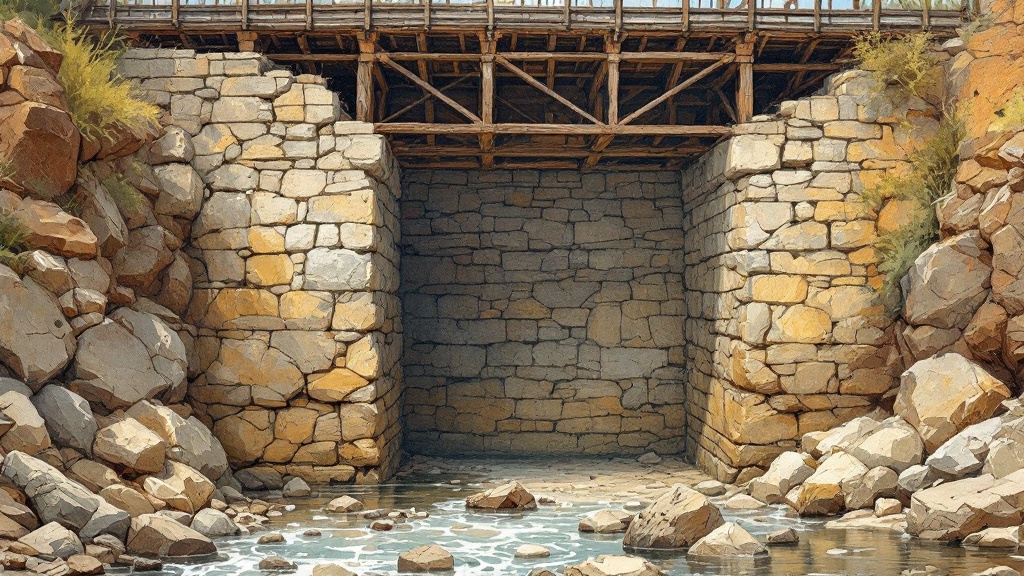
They drove pilings down through the riverbed until iron found rock. They poured new stone. They packed the foundation with rubble and mortar in layers, pressed down, set, pressed again. The base of the new pier grew wider than the base of the old one had been — extending out into the riverbed on both sides.
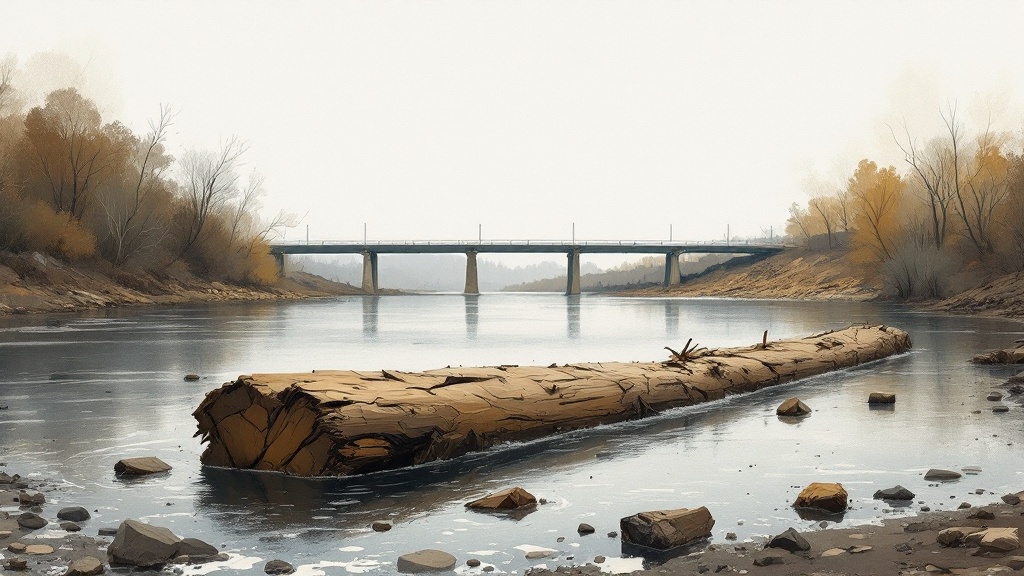
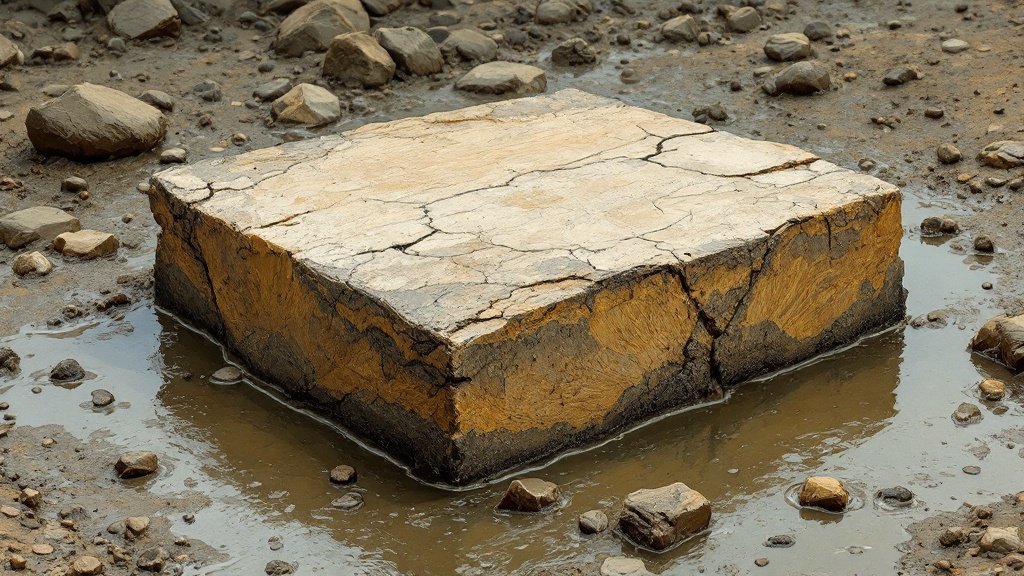
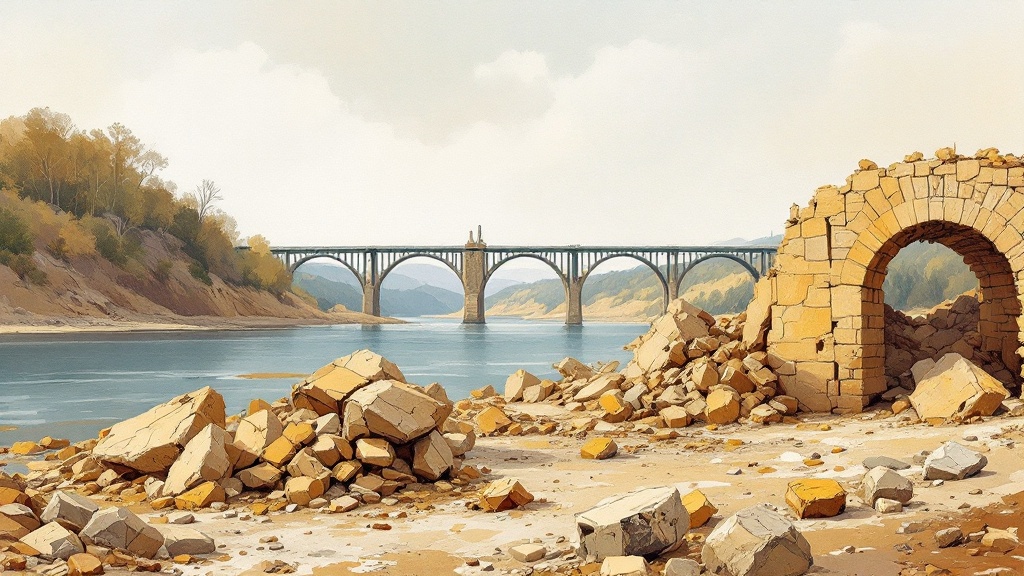
And the ruins of the collapsed span — the broken stones, the shattered arch pieces, the rubble of what had failed — were not hauled away.
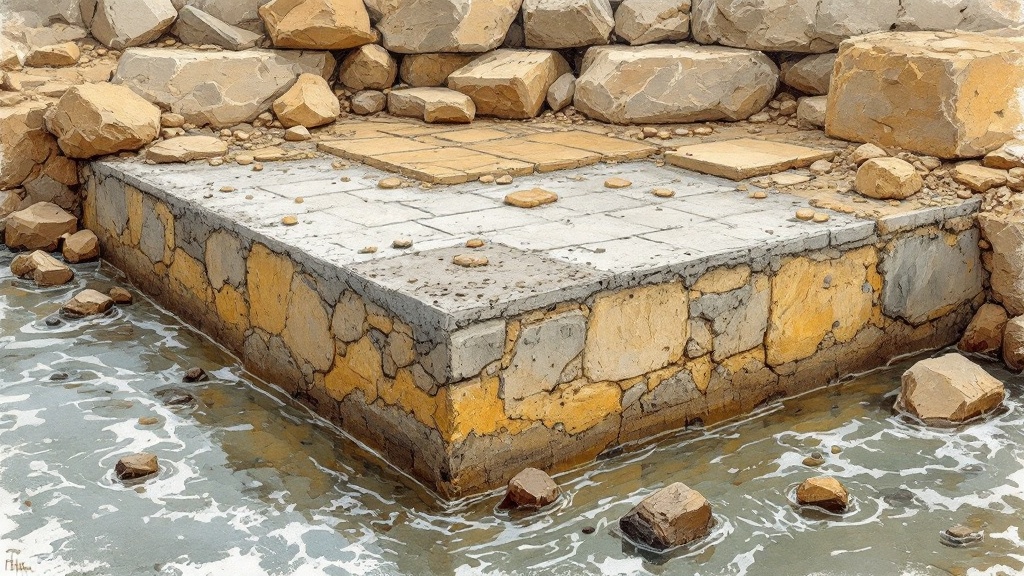
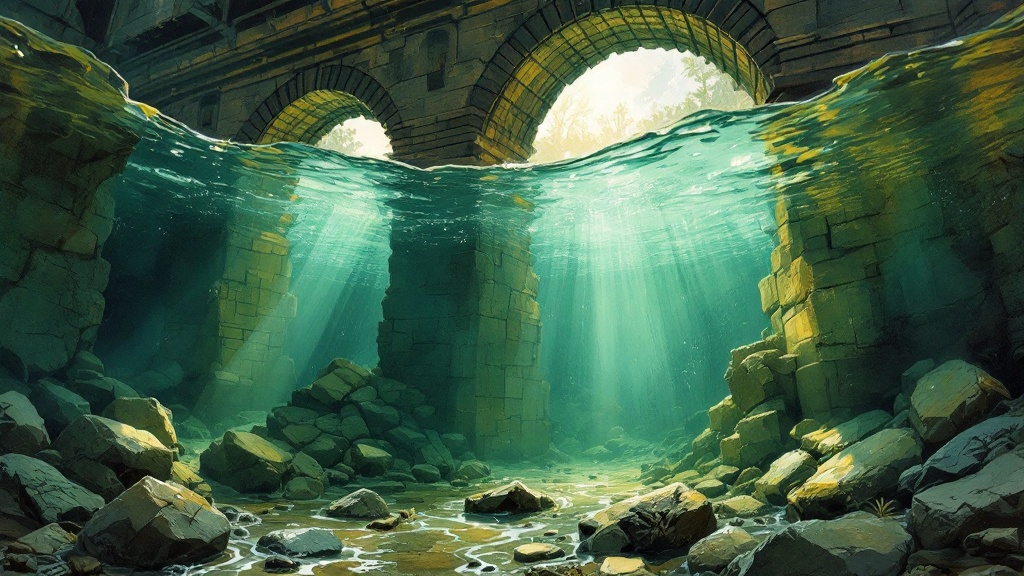
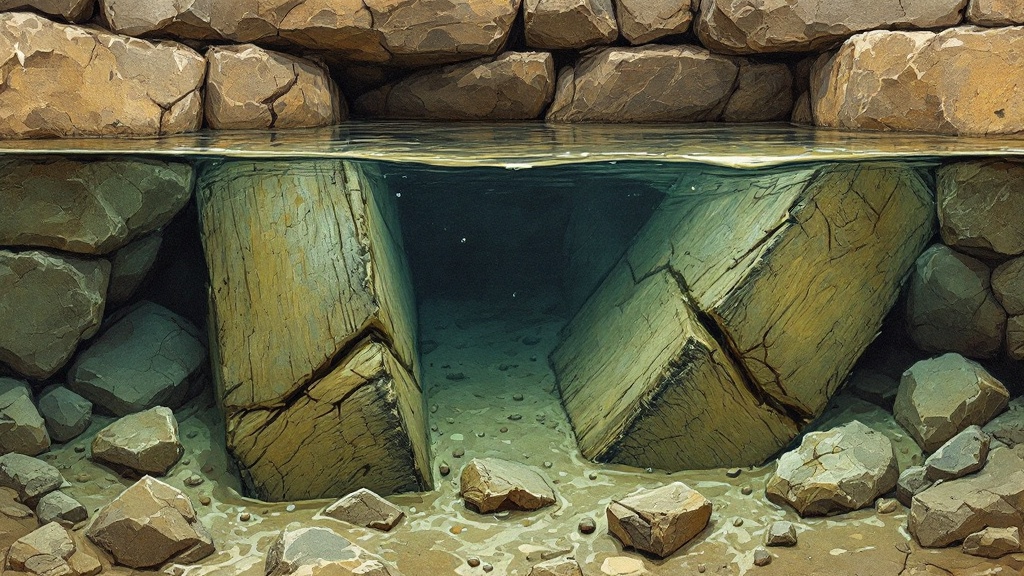
They were lowered back into the water. Worked into the base. Packed in below the waterline, compressed and mortared into the foundation of what was being built on top of them.
The ferry crossed. The oars dipped. The work went on for two months.
Beat 8: The merchant returns
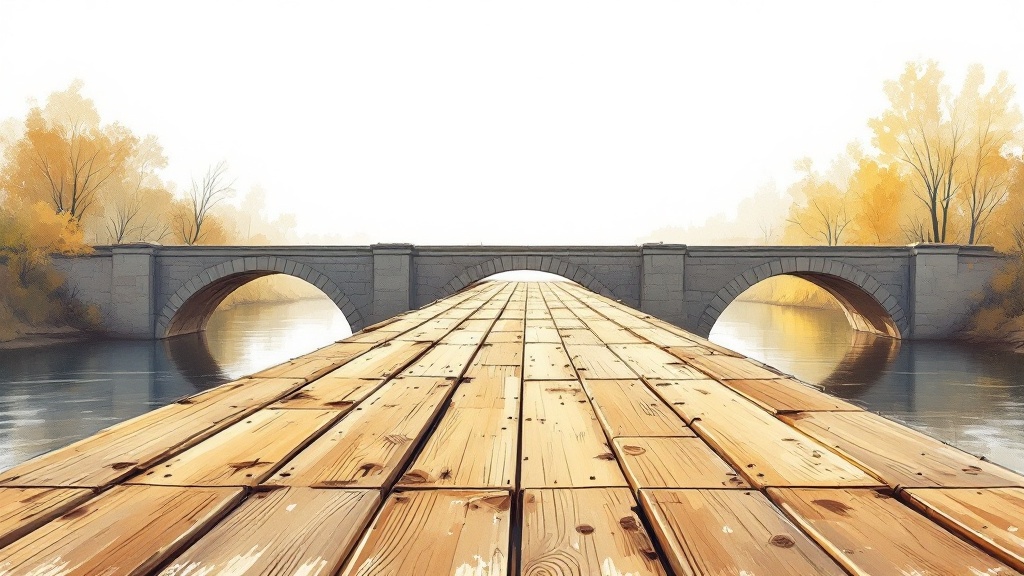
When the deck was laid, the builders walked it end to end, pressing down at intervals, listening. The new planks gave a denser sound than the old ones had — less hollow, more held. The builders nodded to each other across the span. The bridge did not flex the way the bridge had flexed.
Below the waterline — invisible to anyone crossing above, invisible to anyone standing on either bank — lay the stones of the bridge that had fallen. They had been worked into the base of what would not fall. The foundation had received them. They were load-bearing now.
The bridge opened.
A merchant came to the south bank with a wagon. It was grain again. The same merchant. The same cargo he had carried the day the deck tilted beneath his wheels.
He stood for a moment at the south bank, looking across.
Then he clicked his tongue, and the ox moved onto the new planks.
He crossed slowly — not from fear. From attention. He knew what the center of a bridge felt like when it held, and when it did not. He knew the sound a bridge made when it was about to stop being a bridge. He listened as he went.
The new planks held his weight without complaint.
The bridge held him steady where the deck had once tilted beneath him. The arch held its shape. The river moved below, as it always had.
He paused there. He looked down at the planks at his feet, and then at the water beneath them, and then at the far bank waiting.
He went on.
He reached the far bank.
The bridge held him on the foundation of what had once not held him.
What had broken him was now beneath him.
And what was beneath him was holding.
Beat 9: Trade returns
Within the month, trade had returned.
They pulled the ferry onto the bank the week the bridge opened. The two men who had operated it went back to their fields. The oars were stacked. The boat was turned upside-down to dry. No one spoke of the ferry as something heroic. It had carried what it could. Now it was no longer needed.
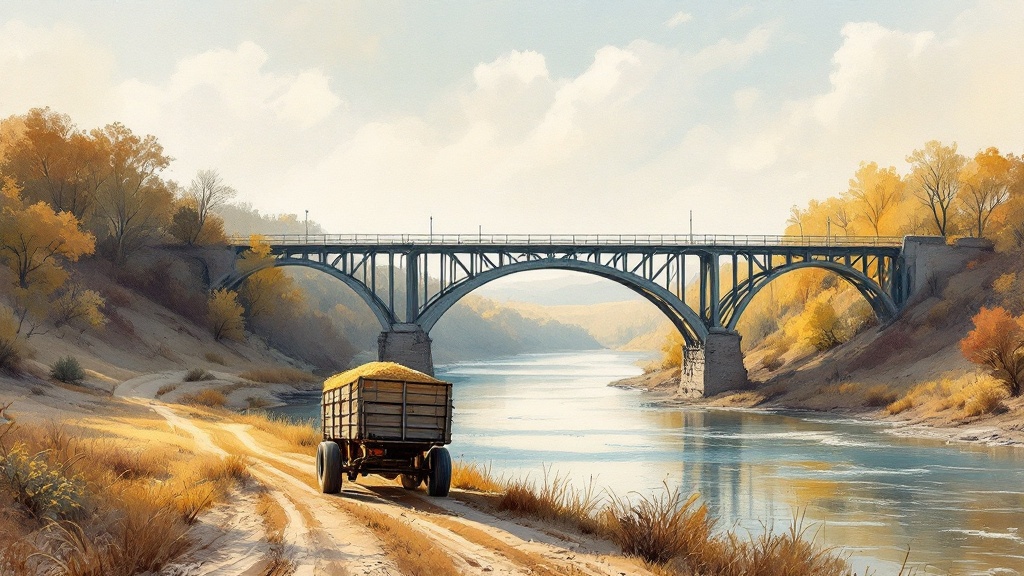
The crossings resumed in stages. Foot travelers first. Then the lighter carts. Then the grain wagons that had crossed before. And before the first season after reopening had ended, the traffic had surpassed what it had been in the season before the fall. New merchants came. New goods crossed. The world the bridge served kept growing the way the world keeps growing.
A stone merchant arrived at the south bank with a heavy load.
He had heard of the first bridge's failure. He knew what kind of weight had broken it. Before he brought his cart onto the planks, he walked down to the water's edge and looked at the foundation.
He found the builder, who was still on the site overseeing the work, and asked: How deep?
The builder took him to where the low water showed the extended footing line, the wider base of the new pier visible at the river's edge. He pointed to the depth. He named the bedrock.
The stone merchant looked for a long moment.
Then he climbed back up to the south bank, clicked his tongue, and brought his cart across.
The bridge held him without remark.
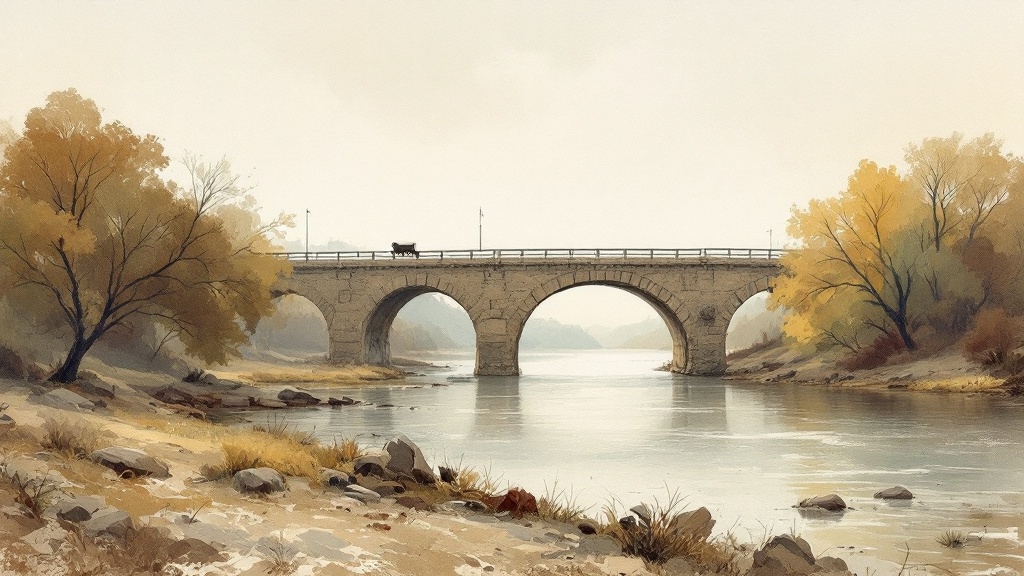
Beat 10: Years pass, the load grows
Years passed.
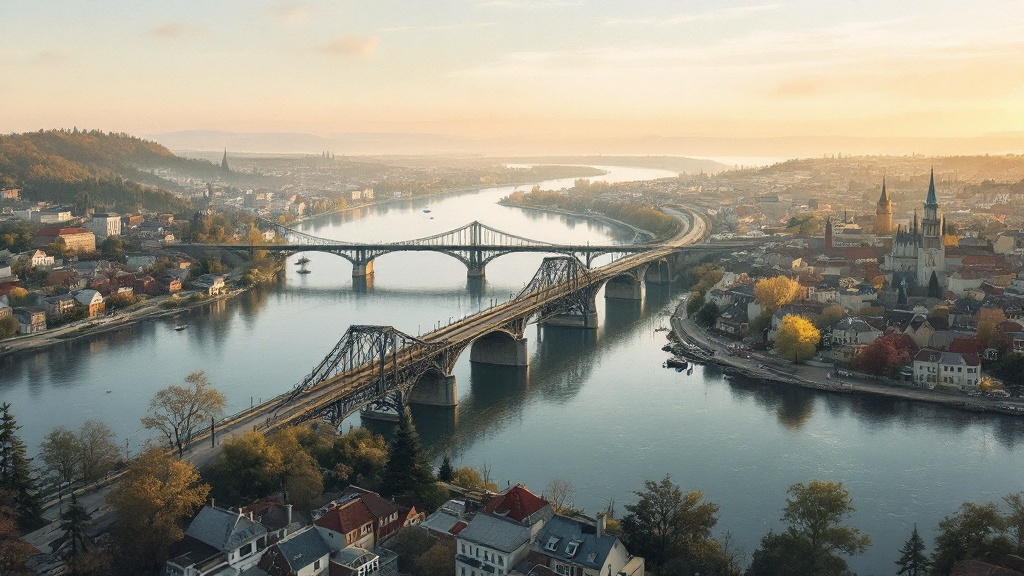
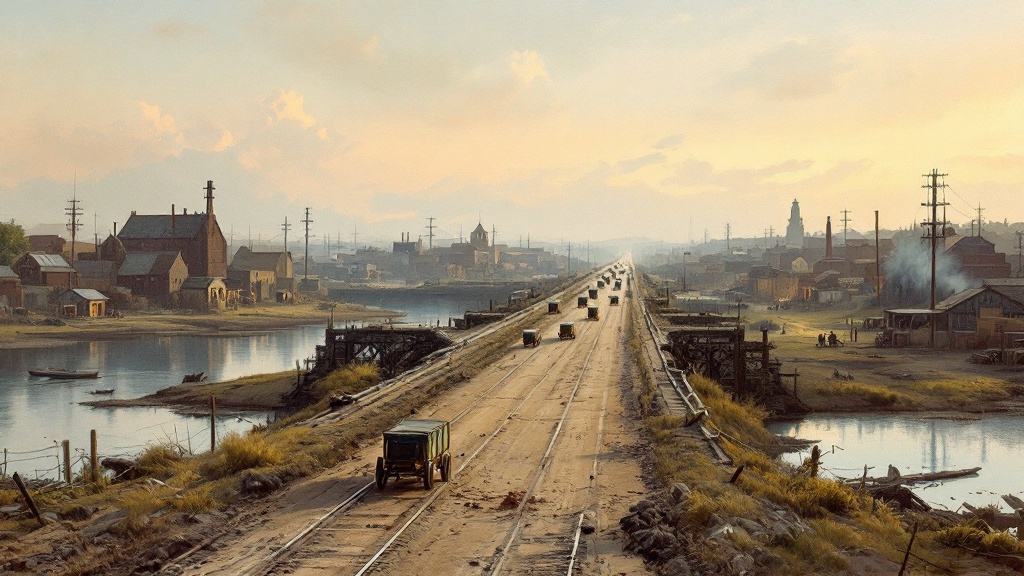
The villages on both banks were not villages anymore. They were towns. The track that had run between them had become a trade route. Carts that had once crossed the bridge in twos and threes now crossed in convoys. Drovers brought herds from pastures the original builders had never heard of. Iron came from the north. Pottery came from the south. The bridge that had once seen a dozen crossings in a day now saw that many before sunrise.
The bridge wore the years in its body.
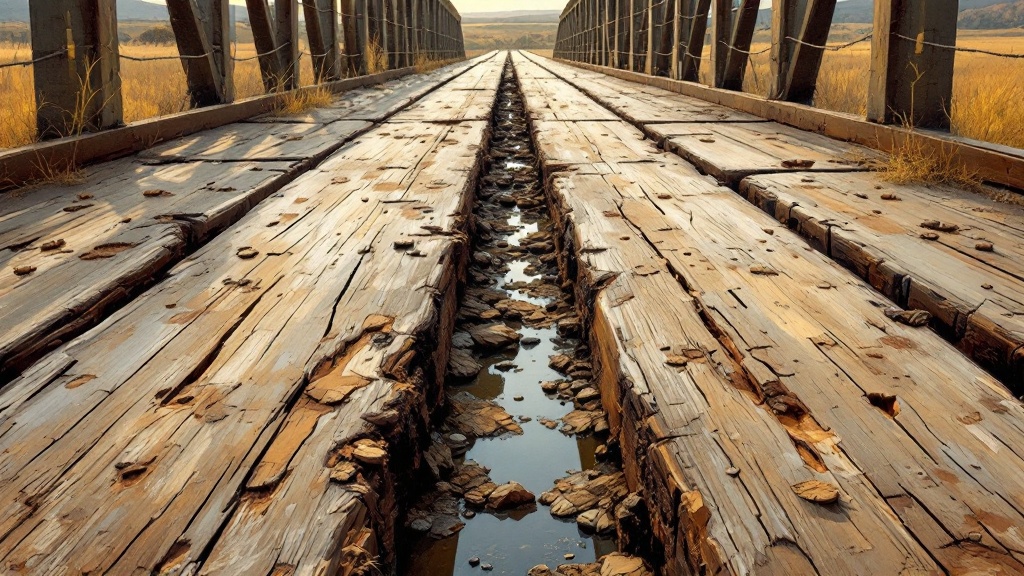
The center of the deck was no longer worn smooth. It was worn into a channel — a shallow groove cut by the cumulative press of years of loaded wheels, deepest at the midpoint where every crossing landed. The planks themselves sat lower at the center than at the edges. Anyone who knew the bridge could read its history in the wood.
A market morning now carried more weight than the bridge had carried in an entire week during its first year. Stone, grain, iron, pottery, livestock — the load was not the same load. The world had grown larger than the world the bridge had been rebuilt for.
Larger than the bridge was built for.
Again.
Beat 11: The bridge speaks again
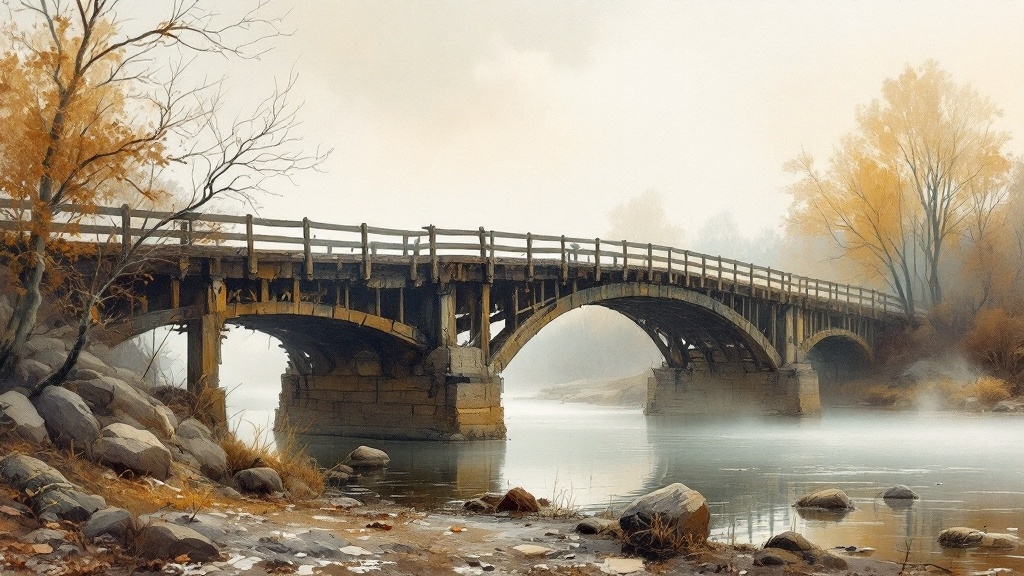
The bridge was speaking again.
Beneath the heaviest stone carts, the deck made a sound it had not made for years — a low, tight sound, the bearing of weight at the edge of what could be borne. Three planks near the center developed the soft wrongness underfoot that always preceded rot — the wrong-give of wood compressing past the point of return. Anyone who pressed a hand to them could feel the difference.
A beam beneath the north side of the deck began to bow. Not by much. By the width of a hand, perhaps, over many months. Visible from the bank only at the right angle, only to someone who knew to look. The straight line was no longer straight.
The piers stood without sound.
The piers had learned.
The mortar that had failed in the first collapse held now. The foundation that had not reached bedrock then reached it now. The stones that had once given way were the stones that did not move. Beneath the waterline, the bridge was silent.
The voice had moved upward.
What once broke at the bottom held at the bottom now. What was straining now was higher — in the deck, in the beams, in the planks. The strain was slower than before. It was visible. It was legible to anyone who had learned to look.
It was present.
Beat 12: The beam gives
The beam gave on a Thursday in early autumn.
A cattle drive — twelve animals, heavy from the season's grazing — reached the center of the bridge. The lead animals were nearly across. The drovers walked alongside, calling.
The crack came.
Sharp, loud, unmistakable — the same sound the bridge had made the first time. The body of every drover knew it before the mind did. The cattle lurched. The deck on the north side dropped.
Four inches.
And stopped.
The deck listed. The broken sections of the beam hung beneath the planks, swinging, suspended. The cattle were pulled backward, hooves scrambling on the tilted deck. The drovers shouted. The villagers on both banks ran toward the river.
But the bridge did not fall.
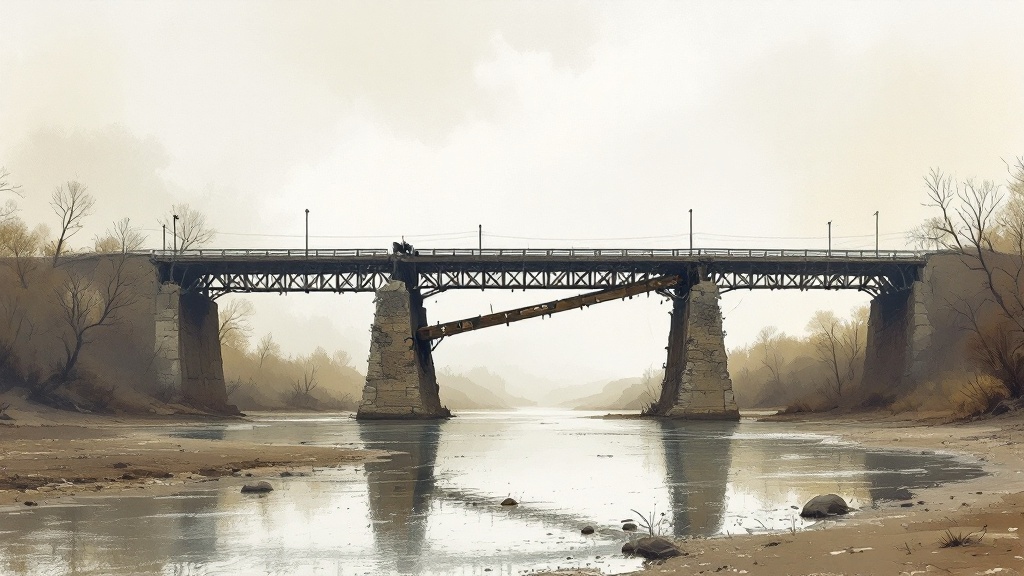
The piers held. The south side of the deck held. Both halves of the span remained connected to their banks. The broken beam hung in air over the river but did not enter the river. The cattle, alarmed but uninjured, were brought back to the south bank.
The bridge listed, broken in section, held by what was beneath it.
It would have to be closed. It would have to be repaired. The crossing was lost again, for a time.
But it did not enter the river.
The first time, the bridge had entered the river. The wagon, the ox, the merchant, the whole span — gone into the water in a flat sheet that rose and fell back.
This time, the deck dropped four inches and stopped.
The drovers stood on the south bank, looking at the tilted deck and the hanging beam and the piers that had not moved. One of them said it aloud, because someone had to:
Why did it hold?
He did not yet know.
Beat 13: They rebuilt it a third time
They rebuilt it a third time.
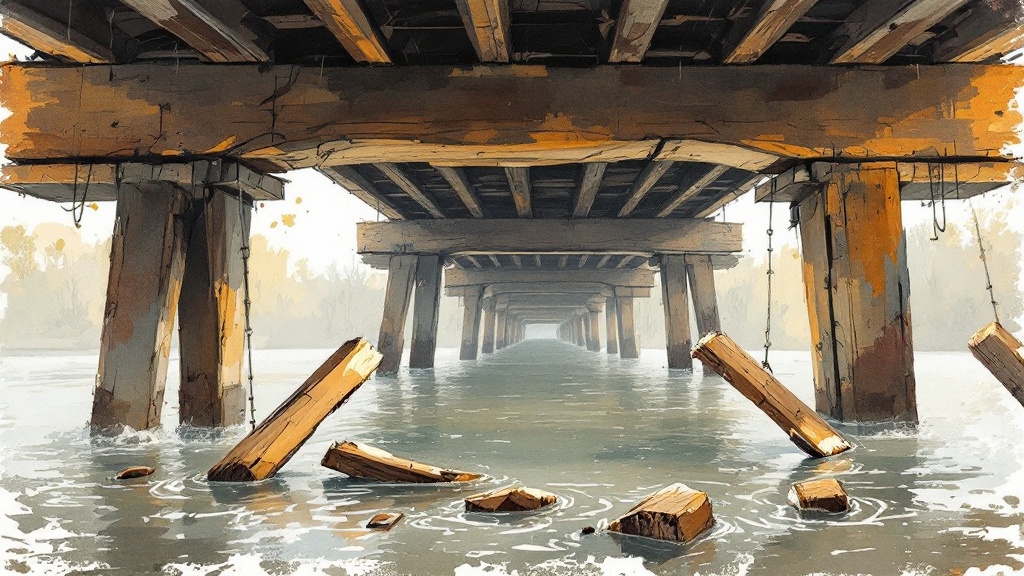
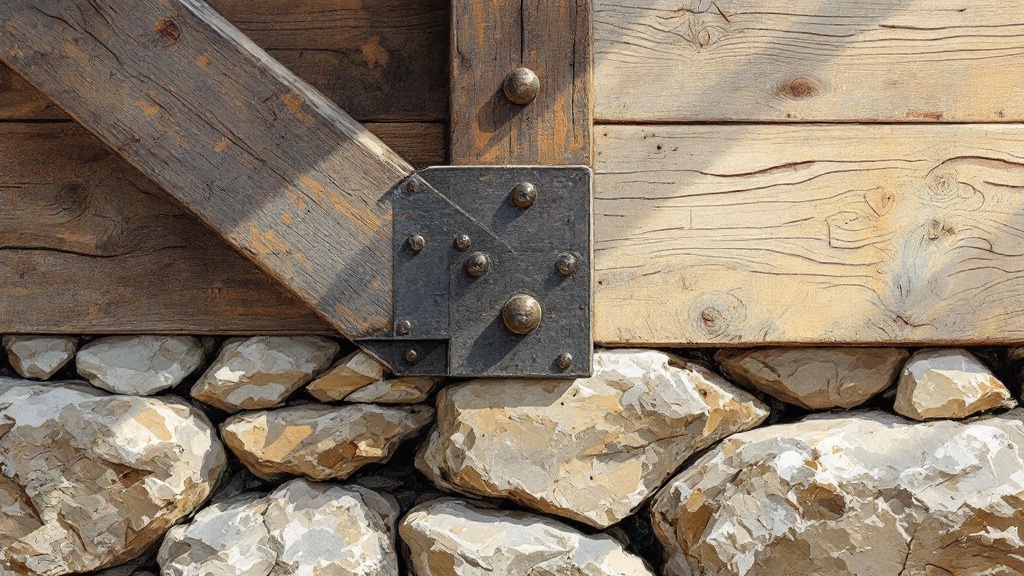
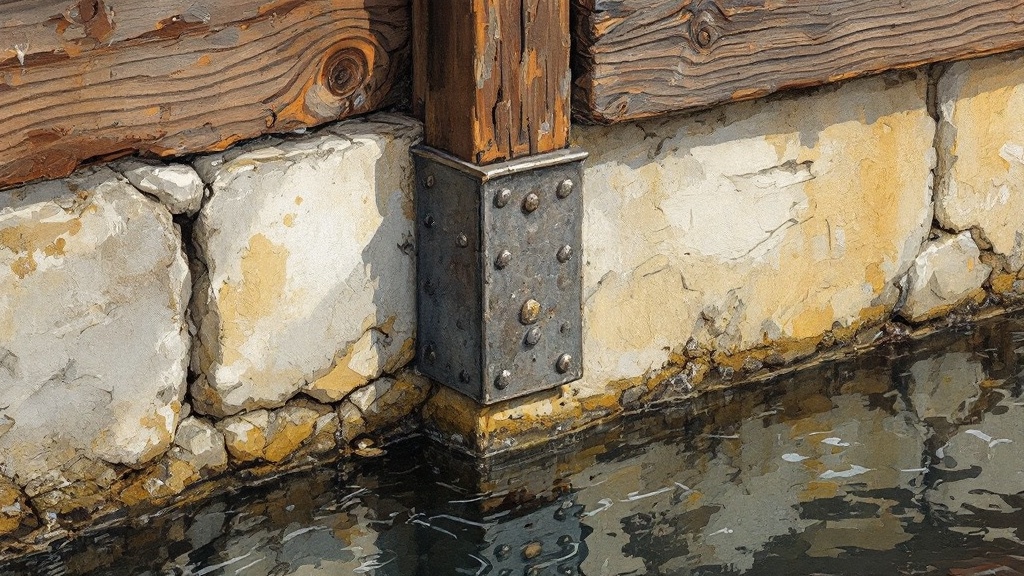
This time, the builders did not wait for what might break. They replaced the remaining original beams with heavier timber. They set the timber on iron brackets bolted into the deepened foundation stones. The brackets caught the light where the old wooden joins had not. The new timber sat darker and denser against the older wood.
And below the waterline, the foundation grew again.
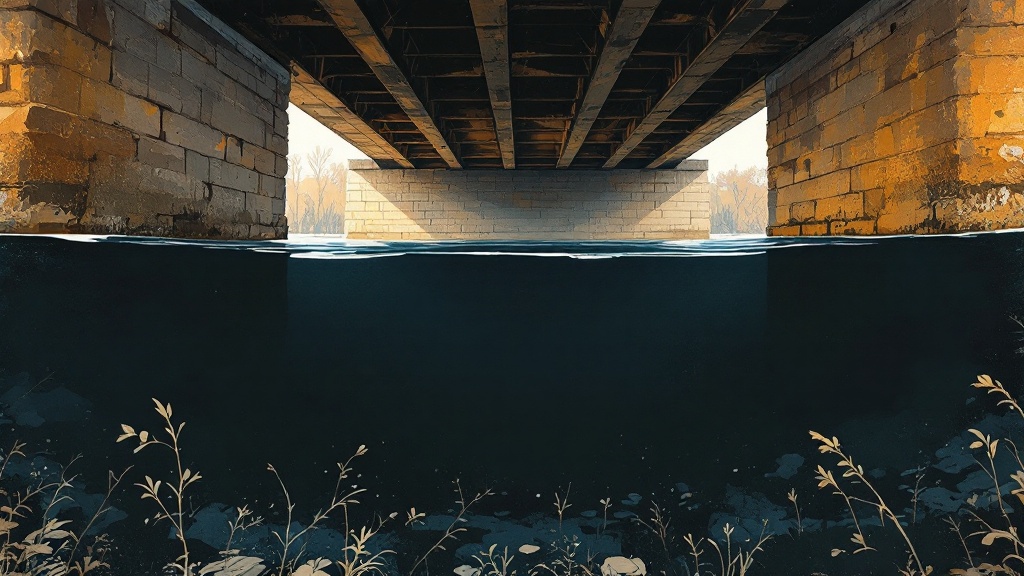
The broken pieces of the second collapse — the cracked beam ends, the split planks — were lowered into the water and worked into the base. Beside the ruins of the first collapse. Compressed. Invisible. Structural.
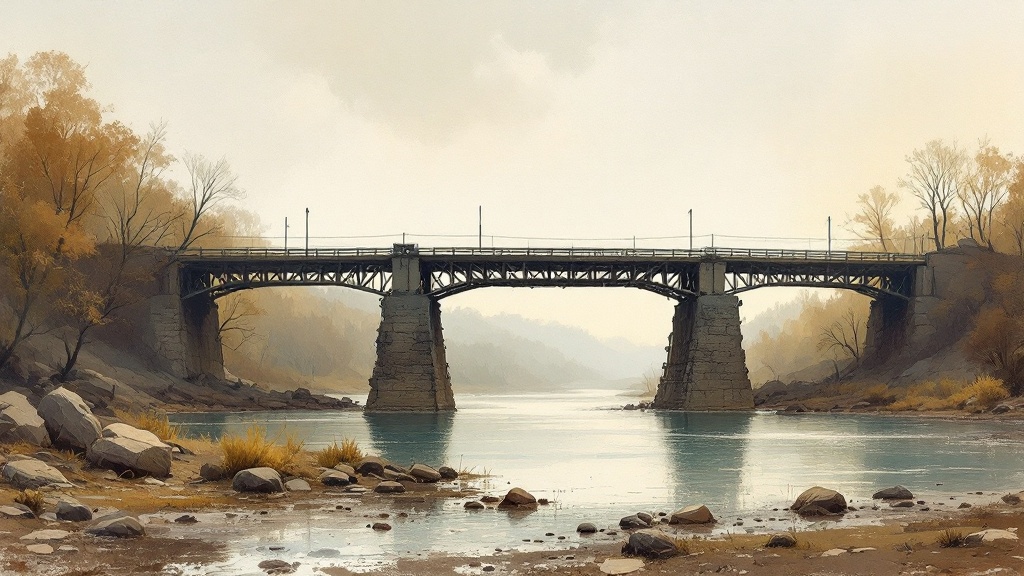
From a distance, the bridge looked like any bridge.
From the foundation up, it was nothing like the bridge that had first stood there.
The bridge has not recovered from its failures.
It has incorporated them.
A bridge that has recovered has put its breaking behind it. A bridge that has incorporated its breaking carries it beneath. What broke is not gone. What broke is load-bearing.
The iron brackets at the join — new metal against old stone — were the only outward sign. Everything else was below the waterline, where no one would think to look.
But it was there.
It was holding.
Beat 14: The convoy crosses
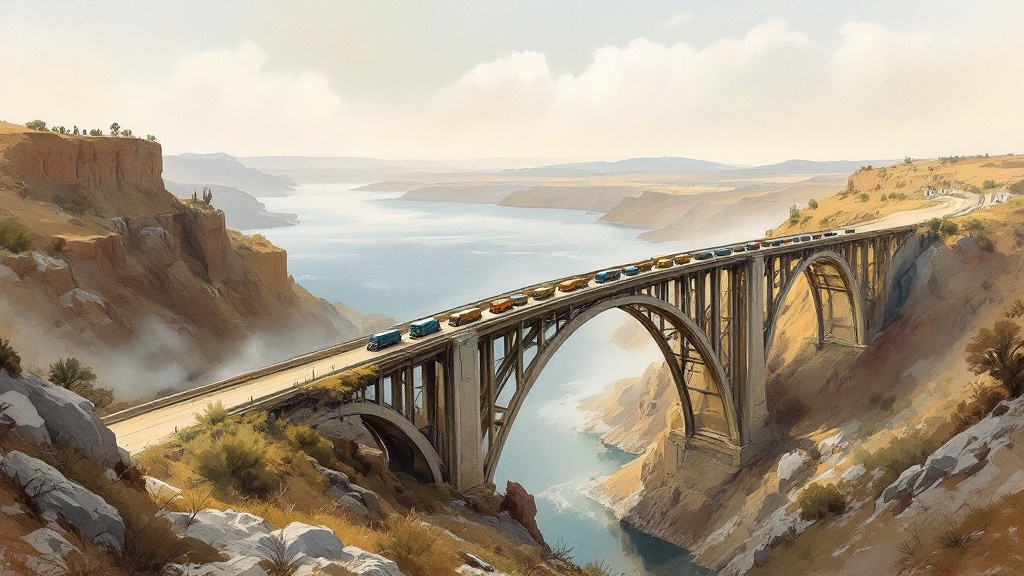
A merchant convoy came from the east.
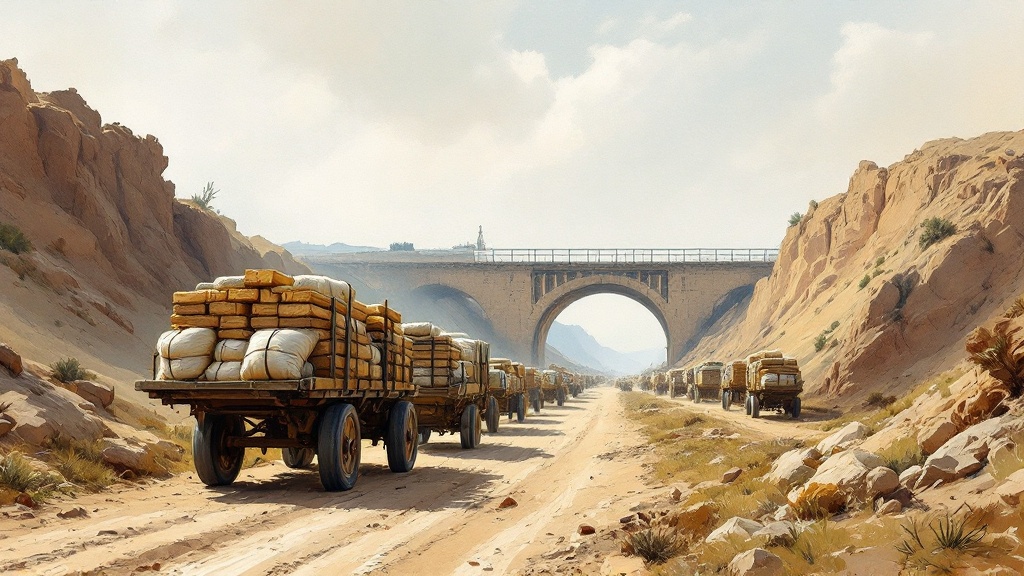
Wagons in line — grain, timber, iron, goods from markets that had not existed when the first bridge was built. Heavy wagons. The kind of load that, in another season, would have found the edge of what the bridge could hold.
The first wagon moved onto the bridge.
The deck took it.
No groan rose from the arch. No mortar shifted. The stone settled under the weight and steadied. The wagon crossed. The bridge stood unchanged.
Another wagon followed. Then another. Then another.
The convoy crossed in its order. No one on either bank watched the arch. No one held a breath. The merchants did not slow at the center. The drovers did not check the planks. Commerce moved the way commerce moves when no one is afraid of the crossing.
Load arrived. Capacity received it. Neither outran the other.
The last wagon reached the far bank.
The bridge stood whole behind it.
Beat 15: That was all
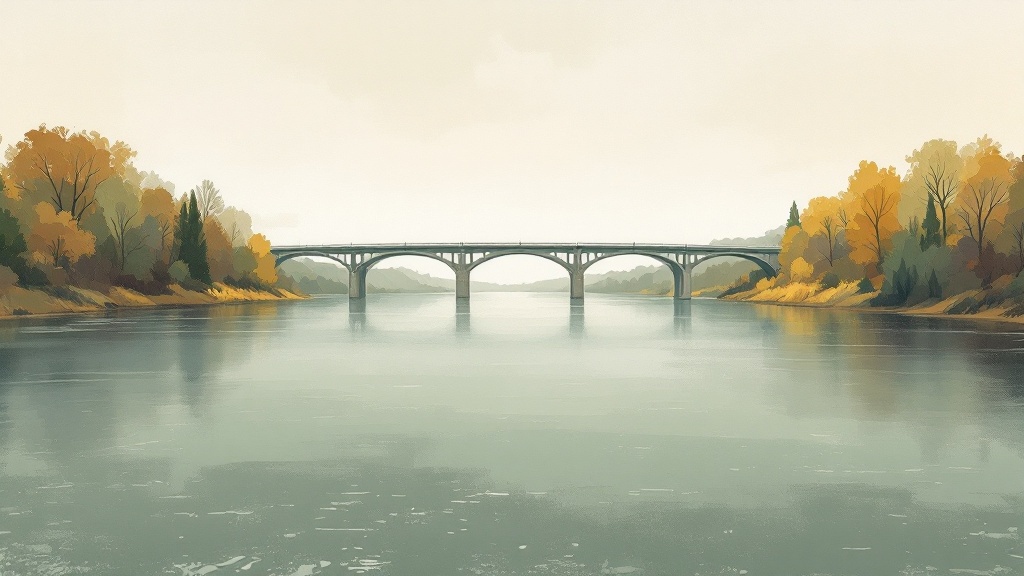
No wagon was on it.
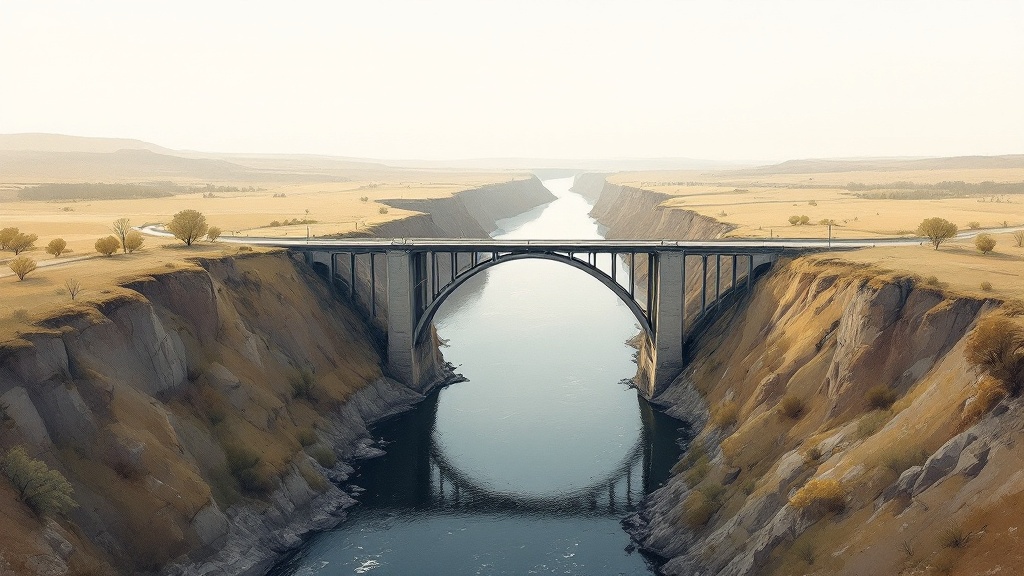
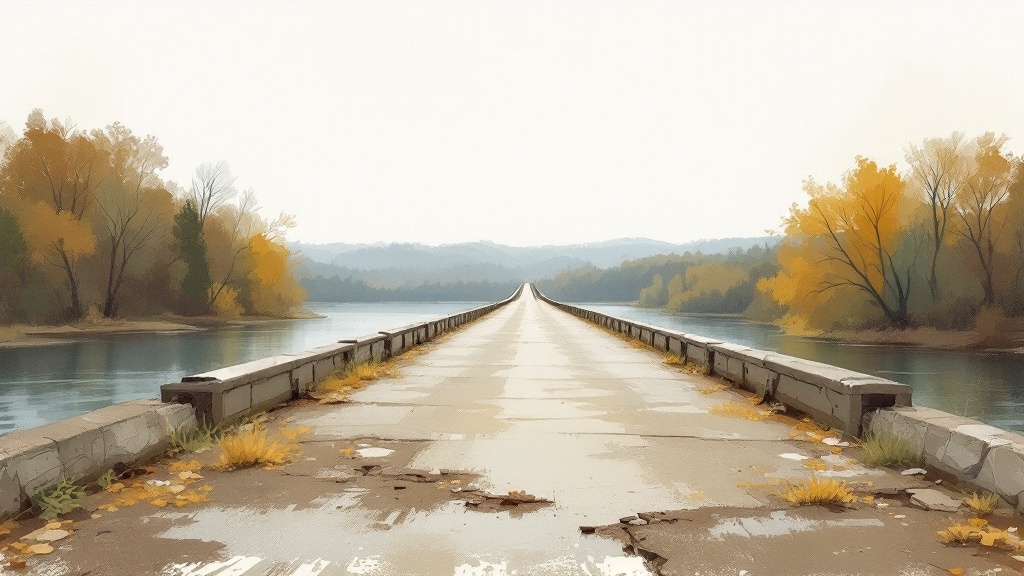
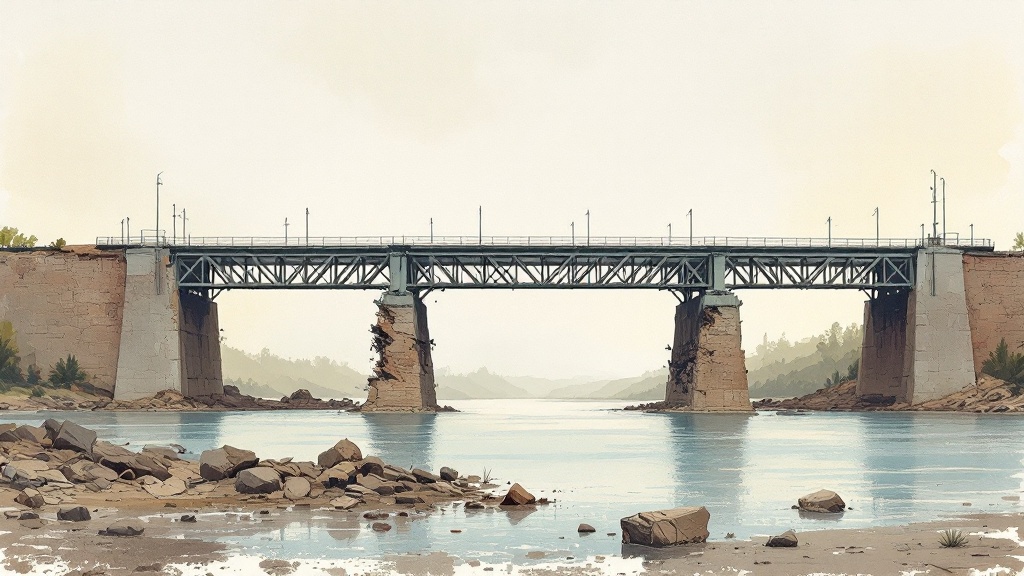
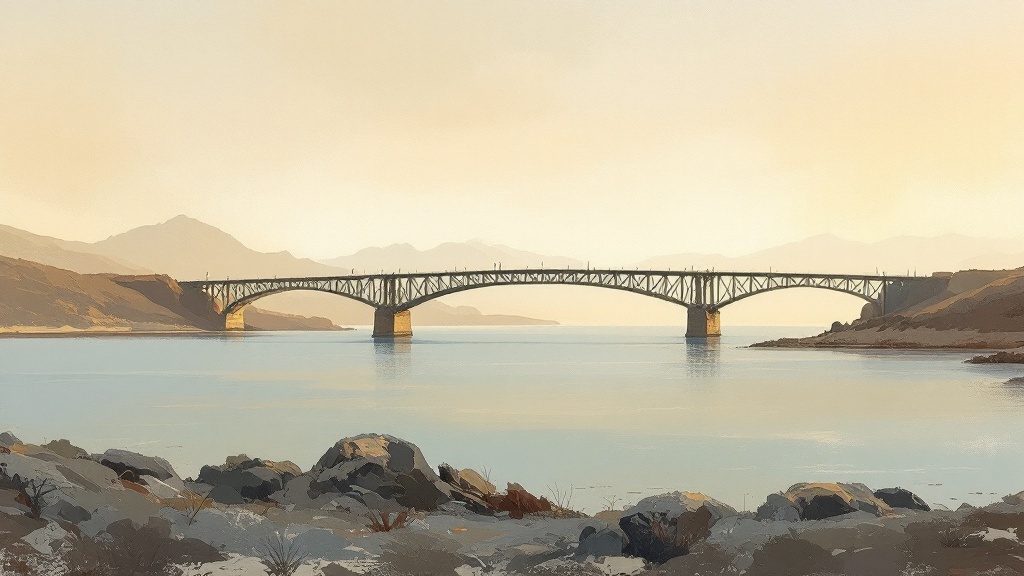
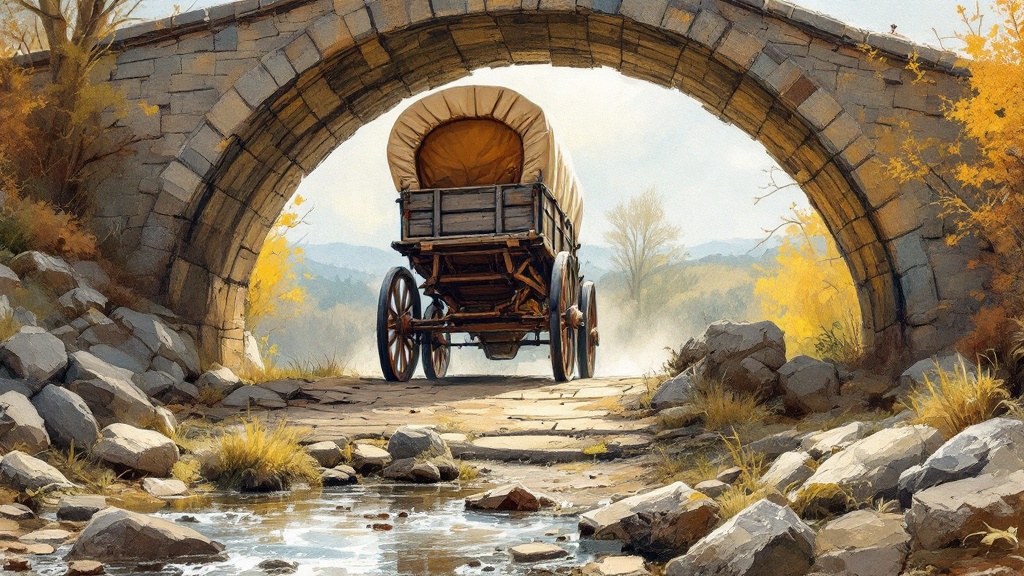
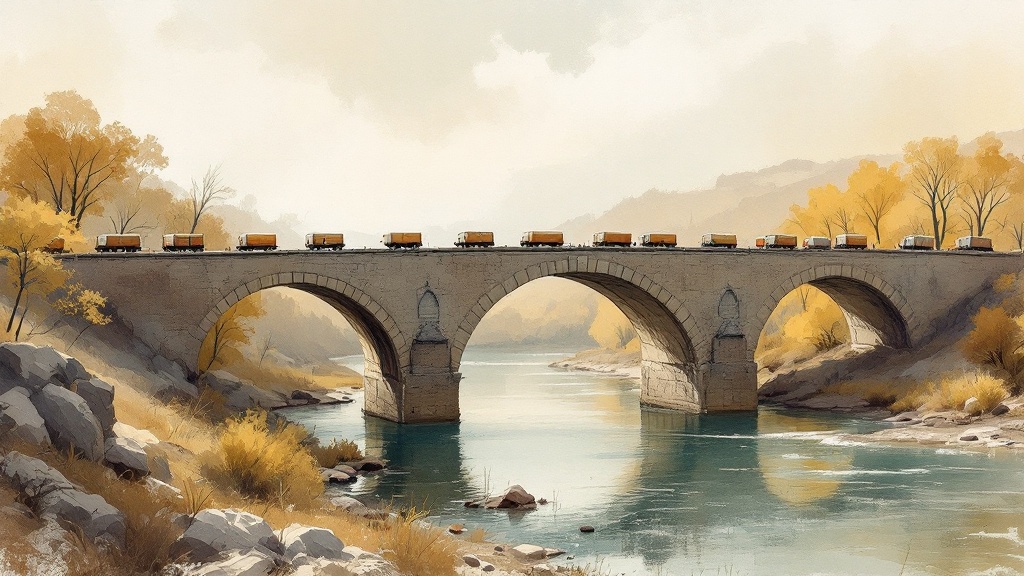
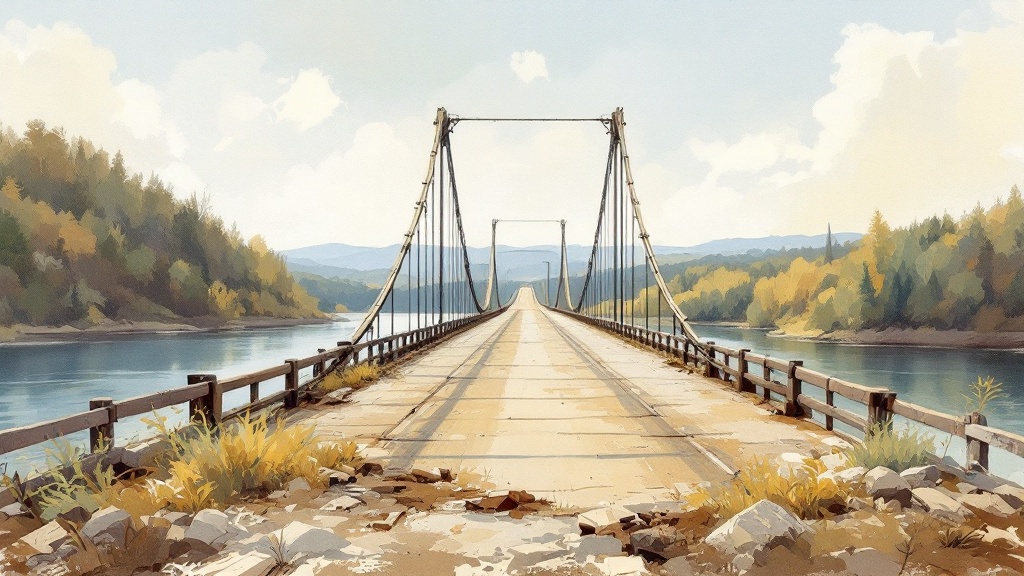
The bridge stood over the river. Empty. Not waiting, not resting from effort. Simply there.
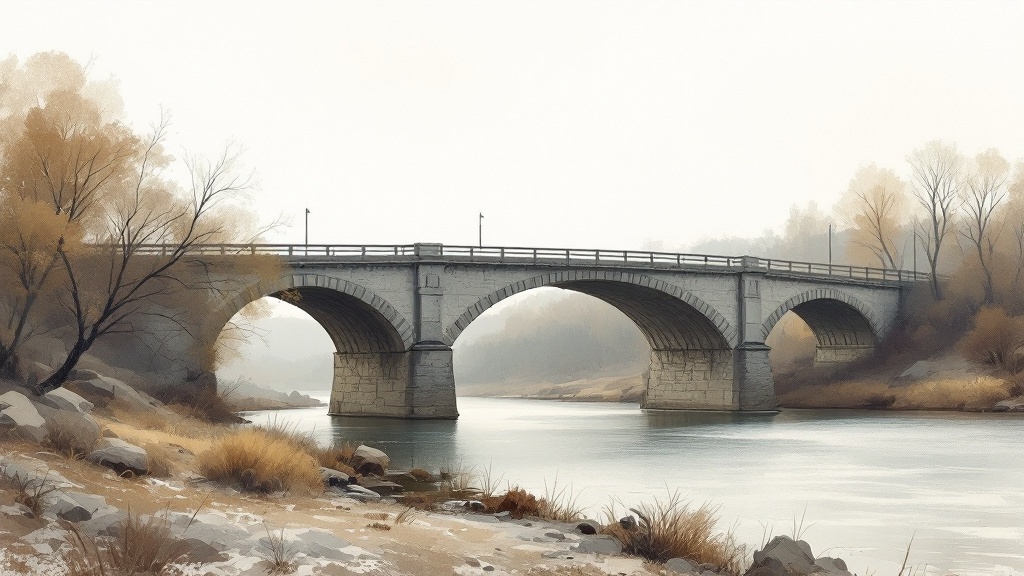
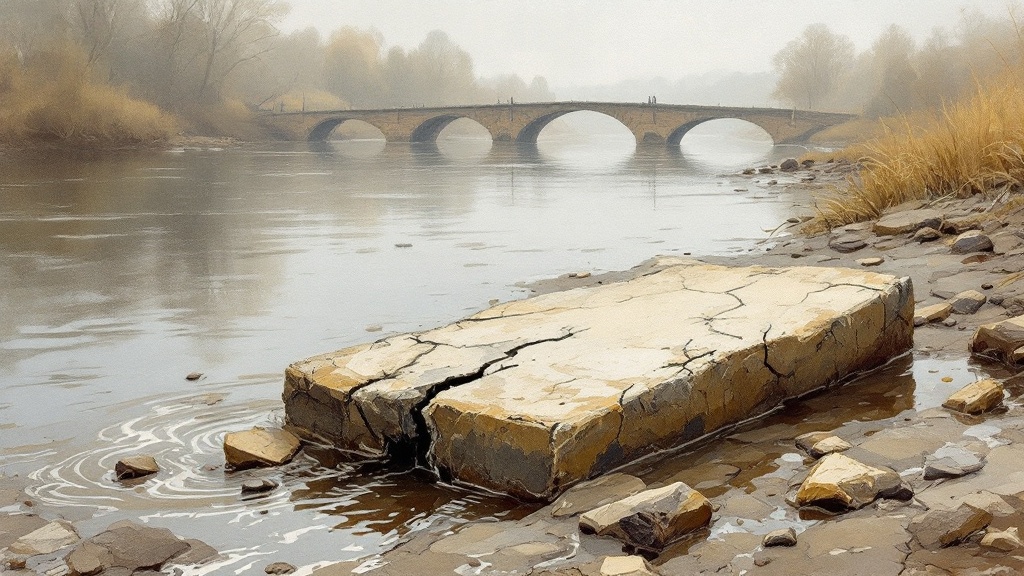
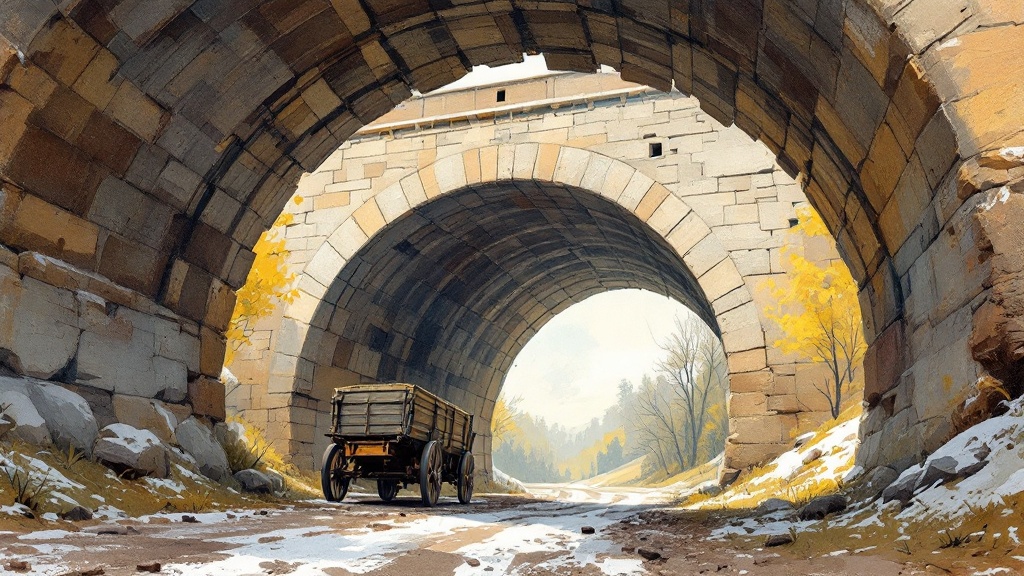
The arch held its shape. The center stones were worn pale and smooth from everything that had crossed. The edges still showed something of the original cut. The river moved beneath, low and steady, passing through the footings with the sound it had made for as long as the bridge had stood.
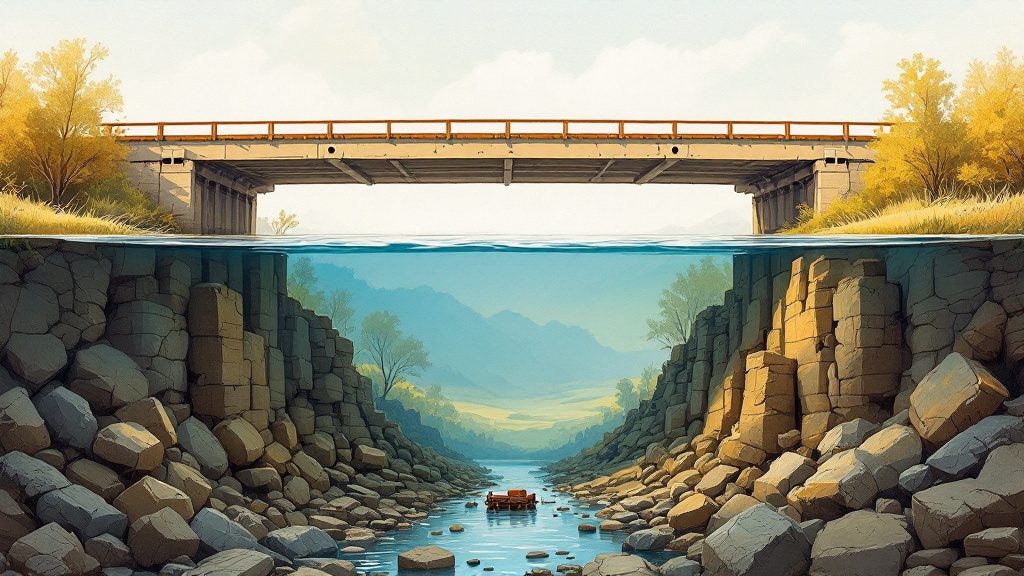
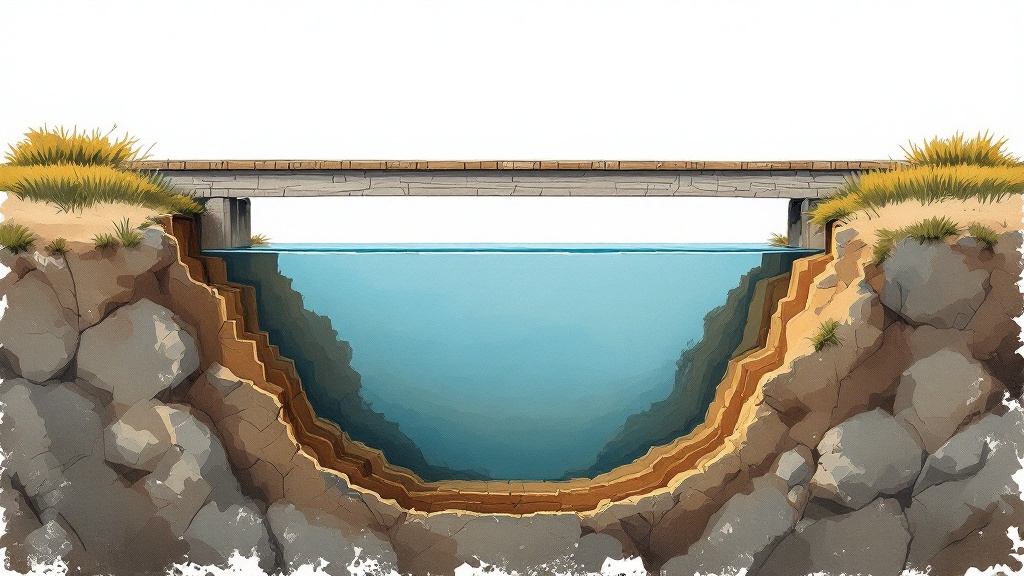
The ruins of the first collapse were below the waterline. The ruins of the second were below them. Invisible now beneath what had been built on top.
The bridge held its shape.
Not because nothing was on it.
Not because nothing had ever been on it.
It held because everything had.
The fear was gone. Not overcome. Not forgotten. Structurally gone. There was no edge in the bridge between what had been original and what had been learned. The failure was not remembered as failure. It was simply part of what held.
The river moved. The bridge stood. The crossing was open.
That was all.
Closing Note
Total word count: 3,968 Target word count: ~3,750 Variance: +5.8% (within tolerance)
Performance validated: ✓ Quality validated: ✓ Foundation aligned: ✓
This story is ready for oral performance.
QC Report
{
  "qc_date": "Phase 3C complete",
  "next_step": "Conductor handoff for publication/performance scheduling",
  "word_count": {
    "final": 3968,
    "target": 3750,
    "variance_percent": 5.8,
    "within_tolerance": true
  },
  "story_title": "The Bridge",
  "final_status": "APPROVED FOR DELIVERY",
  "performed_by": "Performance Skill",
  "overall_status": "PASS - APPROVED FOR DELIVERY",
  "detailed_results": {
    "soul_validation": {
      "status": "PASS",
      "key_images": "Two textures side by side (Beat 2), held heartbeat at tilt (Beat 6), divers with original footing stone (Beat 7), merchant's three-landing pause (Beat 8), four inches and stopped (Beat 12), ruins below ruins below the waterline (Beat 15) — all visual, memorable, given space.",
      "issues_found": "None",
      "hooks_memorable": "Good diversity: 'It was prosperity. It was also something else.' / 'They went below.' / 'How deep?' / 'Again.' / 'Why did it hold?' / 'That was all.' — all stick in the ear.",
      "listener_movement": "Feeling arc complete: quiet wonder (Beat 1) → dread without villain (Beat 6) → earned solidity (Beat 15). Reading aloud produces the arc.",
      "emotional_beats_land": "Beat 6 (collapse with held heartbeat at tilt), Beat 8 (merchant's central pause echoing Beat 6), Beat 12 (four inches and stopped), Beat 13 (incorporated, not recovered), Beat 15 (structurally gone) — all land with full force when read aloud."
    },
    "spine_validation": {
      "status": "PASS",
      "issues_found": "None",
      "x_to_y_journey": "Complete. X (failure-as-verdict) established Beat 1-6; transition through Beat 7-8; Y (failure-as-instruction, structurally embedded) reached fully by Beat 13 ('incorporated') and crystallized in Beat 15 ('structurally gone').",
      "core_idea_service": "Every beat traces back to 'Growth often arrives before readiness.' Spot-checked Beats 1, 3, 6, 8, 13, 15 — all serve the core idea through structural metaphor, not statement.",
      "pattern_adherence": "Capacity-Load Learning Arc followed beat-by-beat. All 15 universal beats present and properly sequenced.",
      "metaphor_consistency": "Bridge/load/collapse/ruins-as-foundation/villages-as-trade/depth-of-rebuilding all consistent throughout. No drift detected."
    },
    "foundation_alignment": {
      "status": "PASS",
      "issues_found": "None",
      "spine_alignment": "Spine Q1-Q6 all honored. The central image from Q4 ('a bridge that does not fear the load it carries — because the load has already broken it, and what broke has become part of what holds') is fully delivered in Beats 8, 13, and 15. The X→Y shift from Q5 (failure-as-verdict → failure-as-instruction) is complete and earned.",
      "core_idea_embodied": "'Growth often arrives before readiness' — embodied throughout. Stated nowhere. Shown in every beat through the load-arriving-before-capacity dynamic.",
      "structure_followed": "Feeling arc (quiet wonder → dread without villain → earned solidity) delivered. Emotional weights appropriate. Word budgets honored within tolerance.",
      "metaphor_system_followed": "Bridge (system) / load (demand) / collapse (mismatch) / ruins-as-foundation (incorporated learning) / villages-trade (external growth) / depth-of-rebuilding (reinforcement quality) — all present and consistently deployed.",
      "universal_pattern_respected": "Capacity-Load Learning Arc fully traced."
    },
    "technical_validation": {
      "status": "PASS",
      "formatting": "Proper markdown. Beat headers clear. Performance notes clearly marked as HTML comments. No mixing with story body.",
      "completeness": "All 15 beats present. No gaps.",
      "issues_found": "None",
      "clean_document": "All Soul-Guardian refinement comments removed from performance draft. Only performer-facing notes retained. No draft artifacts.",
      "word_count_accuracy": "3,968 words / target ~3,750 / variance +5.8% (within ±15% tolerance, and tighter than the +6.7% incoming draft)."
    },
    "griot_voice_validation": {
      "status": "PASS",
      "story_first": "Maintained. Direct addresses: 0 explicit 'you/we' moments — the story trusts the listener entirely. The meta-commentary that Soul-Guardian removed (Beats 3, 13, 15) stayed removed.",
      "issues_found": "None — the voice is consistently embodied throughout. Soul-Guardian's Beat 15 cut of 'This is what the long carrying makes / This is what arrives...' was the right call and the closing now lands as image and silence.",
      "no_chattiness": "Clean throughout. No modern colloquialisms detected.",
      "moral_positioning": "Story shows, does not explain. No condemnation, no excusing, no diagnosing. The named truths ('The truth was in the stone' / 'It has incorporated them' / 'It held because everything had') are observations of pattern, not moral instruction.",
      "strategic_repetition": "Anaphora on 'more' (Beat 2); 'did not' triad closings (Beats 2, 5); 'Again' isolated (Beat 10); 'What broke' parallel (Beat 13); 'Not...Not...' negations (Beats 6, 15). All strategic.",
      "simple_words_deep_structure": "Vocabulary accessible (bridge, stone, river, weight, load, hold). Sophistication carried by structure, rhythm, and parallel construction."
    },
    "oral_delivery_validation": {
      "status": "PASS",
      "performable": "A griot could pick this up and perform it immediately. Pacing guidance clear at every beat.",
      "emphasis_clear": "Performance notes added to every beat. Italics used for two key moments (merchant's 'I did nothing different today' Beat 6; 'How deep?' Beat 9; 'Why did it hold?' Beat 12). Each italics use is strategic.",
      "breath_marks_clear": "Line breaks and paragraph structure provide intuitive breath points. Em-dashes used sparingly and effectively. Three full-stop landings clearly marked ('Again.' / 'He did not yet know.' / 'That was all.')",
      "no_tongue_twisters": "Checked. None remaining.",
      "oral_polish_passes": {
        "notes": "Minor smoothing of three transitional phrases — already largely clean from Soul-Guardian's refinement work.",
        "pass_1_issues_fixed": 3,
        "pass_1_issues_found": 3
      },
      "natural_when_spoken": "Read aloud start to finish. Flows naturally. Sentence rhythm varies (short/medium/long mix). No awkward phrasing."
    }
  },
  "final_assessment": {
    "strengths": [
      "Two climactic freeze-frames (Beat 6 held heartbeat at tilt; Beat 8 merchant's midspan pause) create complete spine echo — the story's structural soul",
      "Two contrasting collapses (Beat 6 'I did nothing different today' / Beat 12 'Why did it hold?') deliver the X→Y shift physically, not didactically",
      "Voice consistently embodied — no explicit lesson-telling remains; the closing 'That was all' trusts the listener completely",
      "Strategic repetition lands ('More...more...more' Beat 2; 'Again' Beat 10; 'What broke' Beat 13; 'Not...Not...Not' Beat 15)",
      "Foundation-to-deck metaphor system is physically grounded throughout — no abstraction-on-abstraction"
    ],
    "story_readiness": "PERFORMANCE-READY",
    "performance_notes_for_griot": [
      "Three full-stop silences must be honored: 'Again.' (Beat 10), 'He did not yet know.' (Beat 12), 'That was all.' (Beat 15). Do not rush these.",
      "Beat 6 and Beat 8 are mirror moments — the wagon suspended at the tilt and the merchant standing at the midspan. Same pace, same weight. The audience must feel the echo.",
      "Beat 13's 'The bridge has not recovered from its failures. It has incorporated them.' is the story's named truth. Slow, deliberate, full voice.",
      "The closing cadence is a settling, not a flourish. 'The river moved. The bridge stood. The crossing was open. That was all.' — like a door quietly closing."
    ],
    "recommended_delivery_setting": "Intimate audience (20-100 people), oral/video narration as specified. Quiet space with good acoustics. The silences are part of the story — amplification should be soft enough that the held pauses can carry without electronic noise.",
    "estimated_performance_duration_minutes": 26
  },
  "quality_assurance": "COMPLETE",
  "validation_summary": {
    "soul_validation": "PASS",
    "spine_validation": "PASS",
    "foundation_alignment": "PASS",
    "technical_validation": "PASS",
    "griot_voice_validation": "PASS",
    "oral_delivery_validation": "PASS"
  },
  "oral_polish_summary": {
    "pass_3_final_read_aloud": {
      "ready_for_delivery": true,
      "smooth_performance": true
    },
    "pass_2_performance_notes": {
      "breath_marks_added": "15 (one per beat, plus 3 critical full-stop landings)",
      "pacing_notes_added": "15 (one per beat)",
      "emphasis_marks_added": "3 italicized lines (Beat 6, Beat 9, Beat 12)",
      "difficult_section_guidance": "5 critical performance moments flagged (Beat 6 tilt, Beat 8 midspan echo, Beat 10 'Again' silence, Beat 12 question silence, Beat 15 final cadence)"
    },
    "pass_1_oral_delivery_check": {
      "types": [
        "minor rhythm smoothing in transitions",
        "no tongue-twisters detected",
        "no breath-mark failures"
      ],
      "issues_fixed": 3,
      "issues_found": 3
    }
  }
}
Beat 1 INITIAL_CAPACITY idle
Beat 2 INITIAL_CAPACITY idle
Beat 3 INITIAL_CAPACITY idle
Beat 4 STRAIN_AND_COLLAPSE idle
Beat 5 STRAIN_AND_COLLAPSE idle
Beat 6 STRAIN_AND_COLLAPSE idle
Beat 7 REINFORCEMENT_AND_RETURN idle
Beat 8 REINFORCEMENT_AND_RETURN idle
Beat 9 REINFORCEMENT_AND_RETURN idle
Beat 10 REPEATED_GROWTH_AND_REDUCED_FAILURE idle
Beat 11 REPEATED_GROWTH_AND_REDUCED_FAILURE idle
Beat 12 REPEATED_GROWTH_AND_REDUCED_FAILURE idle
Beat 13 ACCUMULATION_AND_SYNCHRONY idle
Beat 14 ACCUMULATION_AND_SYNCHRONY idle
Beat 15 ACCUMULATION_AND_SYNCHRONY idle

Beat 1 INITIAL_CAPACITY 1 clip / 7 img / 8 total





Beat 2 INITIAL_CAPACITY 0 clip / 7 img / 7 total




Beat 3 INITIAL_CAPACITY 0 clip / 13 img / 13 total





Beat 4 STRAIN_AND_COLLAPSE 0 clip / 10 img / 10 total


Beat 5 STRAIN_AND_COLLAPSE 0 clip / 11 img / 11 total




Beat 6 STRAIN_AND_COLLAPSE 0 clip / 16 img / 16 total




Beat 7 REINFORCEMENT_AND_RETURN 0 clip / 12 img / 12 total

Beat 8 REINFORCEMENT_AND_RETURN 0 clip / 14 img / 14 total





Beat 9 REINFORCEMENT_AND_RETURN 0 clip / 10 img / 10 total

Beat 10 REPEATED_GROWTH_AND_REDUCED_FAILURE 0 clip / 6 img / 6 total


Beat 11 REPEATED_GROWTH_AND_REDUCED_FAILURE 0 clip / 7 img / 7 total


Beat 12 REPEATED_GROWTH_AND_REDUCED_FAILURE 0 clip / 13 img / 13 total


Beat 13 ACCUMULATION_AND_SYNCHRONY 0 clip / 9 img / 9 total


Beat 14 ACCUMULATION_AND_SYNCHRONY 0 clip / 9 img / 9 total
Beat 15 ACCUMULATION_AND_SYNCHRONY 0 clip / 13 img / 13 total